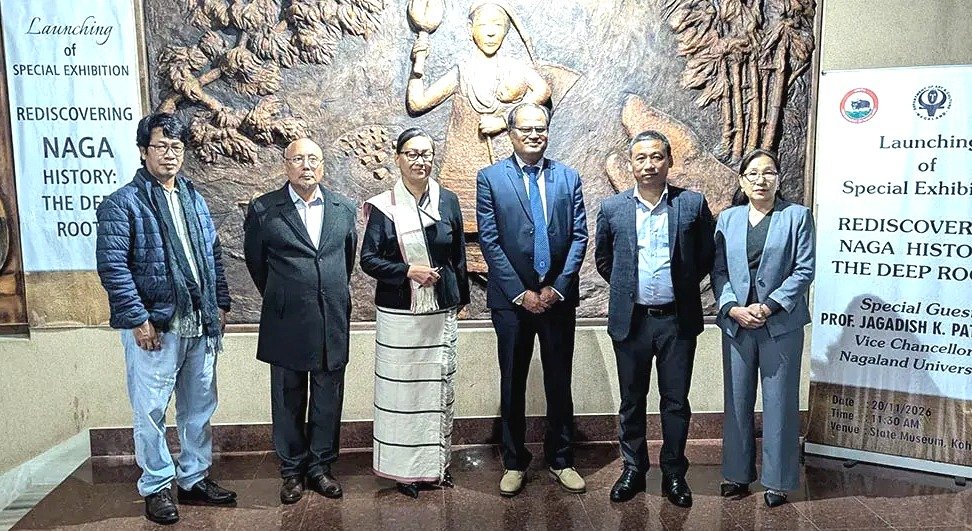
Kohima; November 2026: Yesterday (Friday – 20th November 2026), the Department of Art and Culture and the Department of History and Archaeology, Nagaland University, has exhibited the Archaeological findings from Chipur village in Noklak district - pointing to human settlement dating back to around 1900 BC, with evidence of early farming activities, including the cultivation of millet and Job’s tears, at a special exhibition titled ‘Rediscovering Naga History: The Deep Roots, organised at the State Museum in Kohima.
The exhibition features photographs, excavation records and artefacts recovered from two sites—New Phor village, formerly known as Burakha, in Meluri district and Chipur village in Noklak district. It seeks to encourage a deeper engagement with Naga history through archaeological evidence, beyond colonial-era accounts and other literary narratives.
Speaking at the exhibition, Proffessor Tiatoshi Jamir of Nagaland University has reiterated that the archaeological investigations at Chipur had revealed evidence of early human settlement and farming activity. “We have radiocarbon dates pushing back human settlements in the district to about 1900 BC”, he said. The site had not previously undergone systematic archaeological investigation, apart from brief visits and trial excavations.
Nagaland University undertook an expedition to Chipur in March 2026, during which researchers made significant findings around the caves and rock formations in the village. Proffessor Jamir explained that the research also sought to understand early agricultural history and the domestication of plants in Northeast India, an area of interest to scientists globally. According to him, Nagaland offered an opportunity to deepen understanding of the region's early agricultural practices.
Meanwhile, while revealing the details on the New Phor site, Jamir shared that archaeological work had begun in 1980 under Dr. Vikuosa Nienu, who is regarded as the first Naga archaeologist, who have pursued his doctoral studies at the University of California, Los Angeles.
Nagaland University conducted a trial excavation at the site in December 2008 to supplement and substantiate evidence unearthed during Nienu's earlier work. Recognising its archaeological potential, the university subsequently entered into collaborations with the University of Sydney and La Trobe University, Melbourne
The latest excavations were conducted over two seasons in 2025 and 2026, involving at least three months of fieldwork. Jamir stressed the importance of community participation in archaeological research, saying local support was essential to the process. He has also urged indigenous scholars to move beyond colonial interpretations of Naga culture and heritage, arguing that archaeology offered an opportunity to examine the past through material evidence and an indigenous perspective.
Vice-Chancellor of Nagaland University, Proffessor Jagadish K Patnaik, encouraged the people to engage with their history and said the exhibition could contribute to a stronger sense of identity and confidence. He also suggested digitising oral traditions to preserve them for future generations. Patnaik said the university was making efforts to rediscover lost histories and urged people to contribute to the process as part of their collective identity. He commended the excavation teams led by Jamir and released a documentary titled ‘Burakha: Reading the Land’, based on the New Phor excavation.
Director of Art and Culture, Adela Moa, said the exhibition, originally scheduled for October 2026, had to be deferred due to prior institutional engagements. She described it as a collaborative effort involving the two departments. Adela Moa has further informed that Nienu had donated artefacts recovered during his 1980 excavation at Burakha to the State Museum. The collection will be shifted to the museum's archaeological gallery for permanent display.
The exhibition comprises 15 photographic information panels and eight display tables showcasing artefacts recovered from the sites. It presents aspects of material culture, subsistence and settlement history, besides documenting Nienu's pioneering archaeological work at Burakha.
Chuthitu Thurr, former village council chairman of New Phor, shared that the community had initially faced challenges in facilitating the excavation but secured the support of the local MLA and the Pochury Hoho. He said the first season's findings indicated human settlement dating to the third and second centuries BC, while results from the second season were awaited. He added that the archaeological materials had been taken to Nagaland University for research and exhibition with the permission of New Phor Village Council and would be returned after the research and display were completed.
Thurr has urged the Department of Art and Culture to take steps towards constructing a museum at New Phor to preserve archaeological materials and provide a place for future generations to study their heritage.
P Khape from Chipur village described the findings as a source of pride for the community and an important contribution to preserving its culture and traditions.
The exhibition will remain open to the public until the Hornbill Festival, after which the displayed materials will be moved to a permanent exhibition space.
Team Maverick.