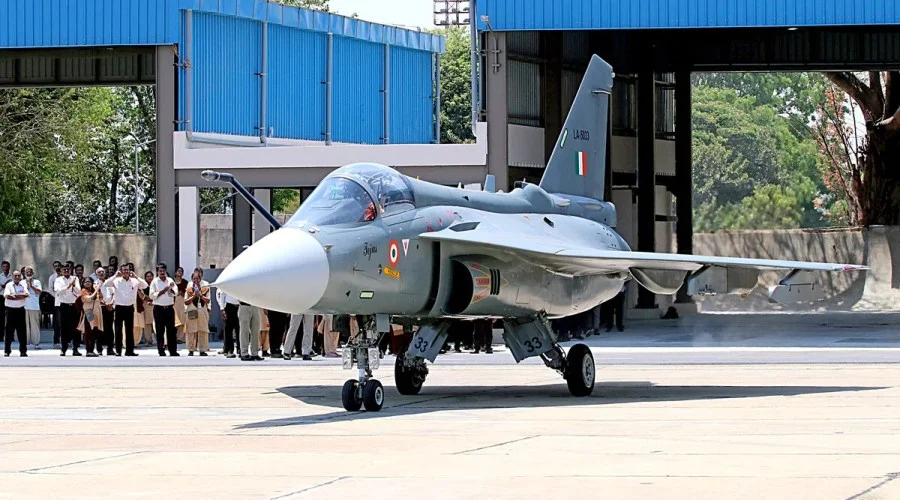
New Delhi, November 2026 : The Indian Air Force (IAF) is expected to receive its first Tejas Light Combat Aircraft (LCA) Mark-1A by January 2027, marking a significant milestone in India's indigenous fighter aircraft programme. Hindustan Aeronautics Limited (HAL) and the IAF are reportedly coordinating closely to complete the handover ahead of Aero India 2027, scheduled to be held from February 8 to 12 at Air Force Station Yelahanka in Bengaluru.
According to defence sources cited by ThePrint, efforts are underway to resolve the remaining technical and integration challenges so that the first aircraft can enter the IAF inventory early next year. The Tejas Mk1A programme has faced considerable delays, primarily due to engine supply constraints and complications in integrating advanced radar and weapons systems.
Engine Supply Delays and Radar Integration Challenges
HAL had initially planned to deliver the first aircraft under its contract for 83 Tejas Mk1A fighters by February 2024. The contract, signed in February 2021, was valued at approximately Rs 36,400 crore.
However, the programme encountered delays following the late delivery of F404-IN20 turbofan engines by US-based GE Aerospace. Challenges involving weapons integration and the certification of onboard systems also affected the production schedule.
Under a 2021 agreement for 99 engines, GE Aerospace delivered its first unit only in March 2025. By September 2026, HAL had reportedly received 14 engines, enabling production activities to progress.
Another major challenge has been the integration of the Israeli ELTA EL/M-2052 Active Electronically Scanned Array (AESA) radar. The system has required extensive software troubleshooting and testing before meeting the required operational standards.
To accelerate the induction process, the IAF has reportedly agreed to accept the initial aircraft with temporary concessions on certain radar functions. The pending software capabilities are expected to be addressed through subsequent upgrades after operational feedback from the Air Force.
Indigenous Uttam Radar for Second Batch
The original plan included the possibility of integrating the Defence Research and Development Organisation's (DRDO) indigenous Uttam AESA radar into later aircraft in the first batch. However, HAL decided in 2025 to install the Israeli EL/M-2052 radar across all 83 aircraft to avoid further certification delays.
The indigenous Uttam radar, reportedly capable of tracking more than 100 targets simultaneously, is now expected to feature in the second batch of 97 Tejas Mk1A fighters.
The follow-on procurement, valued at more than Rs 62,370 crore, was placed in September 2025. Deliveries are expected to begin during the 2027–28 financial year and continue over a six-year period.
Tejas Mk1A Induction Critical for IAF Fighter Squadron Strength
The induction of the Tejas Mk1A is important for the IAF as it seeks to strengthen its declining fighter squadron strength. The Air Force is currently operating around 29 active fighter squadrons against an authorised requirement of 42.
The shortage has increased the urgency of accelerating indigenous fighter aircraft programmes and ensuring timely deliveries from domestic manufacturers.
Air Chief Marshal Ashutosh Dixit, who assumed office as Chief of the Air Staff at the end of October, has identified indigenous fighter development programmes as a major priority for the force. These include the Tejas Mk1A, Tejas Mk2 and the Advanced Medium Combat Aircraft (AMCA).
He has emphasised the importance of rebuilding India's combat capabilities through domestically developed aircraft, sensors and defence technologies to support sustained military operations and strengthen strategic self-reliance.
Advanced Capabilities of Tejas Mk1A Fighter Aircraft
The Tejas Mk1A is an upgraded 4.5-generation fighter aircraft featuring several improvements over the original Tejas Mk1 variant. Its advanced avionics, radar systems and weapons integration are intended to enhance its combat effectiveness.
Key capabilities include:
AESA radar: The EL/M-2052 radar uses electronically steered transmit-receive modules, enabling faster scanning, simultaneous tracking of multiple targets and improved resistance to electronic jamming.
Electronic Warfare Suite: The upgraded electronic warfare system is designed to improve threat detection, situational awareness and aircraft survivability in contested airspace.
Beyond-Visual-Range Missiles: Integration of BVR weapons will allow pilots to engage aerial threats from greater distances without requiring visual contact.
Mid-Air Refuelling: An aerial refuelling probe will extend the aircraft's operational range and patrol endurance, reducing the need for frequent returns to base.
Advanced Avionics: Upgraded onboard systems and integrated mission capabilities are expected to improve pilot awareness and operational flexibility.
HAL and IAF Monitoring Final Certification Requirements
The IAF's project management team, HAL and the relevant certification agencies are closely monitoring the remaining testing and certification requirements, including compliance with the Air Staff Qualitative Requirements (ASQRs).
The immediate focus is on completing the necessary technical assessments, resolving software-related issues and ensuring that the aircraft meets the operational standards required for induction.
If the ongoing testing and troubleshooting schedule remains on track, the first Tejas Mk1A could join the IAF fleet in January 2027.
The induction would represent an important step for India's indigenous defence aviation industry, while providing the Air Force with an upgraded combat aircraft as it works to address its fighter squadron shortfall and reduce dependence on foreign military platforms.
(Disclaimer :The content of this article is sourced from a news agency and has not been edited by the Mavericknews30 team.)