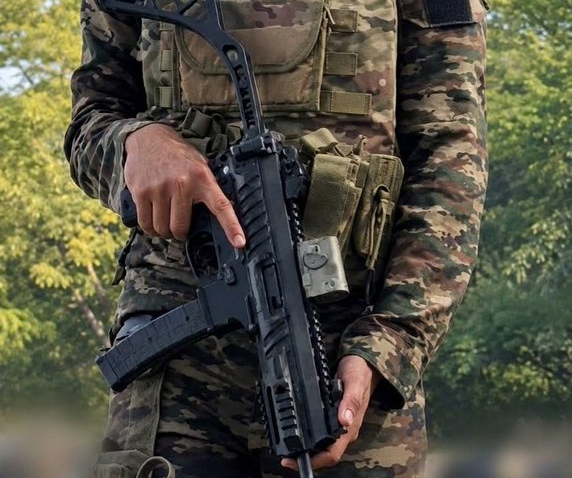
The Indian Army’s Para Special Forces are conducting trials of the indigenous G72 9×19mm submachine gun developed by Bengaluru-based SSS Defence. Designed for close-quarter battle, urban operations and specialised missions, the weapon features a roller-delayed blowback system, folding stock, ambidextrous controls and modular mounting interfaces. The trials will assess its reliability, accuracy, handling, durability and suitability for operational requirements. The evaluation does not by itself indicate formal induction or a confirmed procurement order.
New Delhi, Sept 2026 : The Indian Army’s Para Special Forces are conducting trials of the indigenous G72 9×19mm submachine gun developed by Bengaluru-based SSS Defence, in a move that could provide specialised units with another locally designed small-arms option for close-quarter and other demanding operational environments.
The trials represent an evaluation of an Indian-developed weapon platform against the operational and technical requirements of one of the Army’s specialised formations. The G72 has been designed around the widely used 9×19mm NATO cartridge, also known as 9×19mm Parabellum, potentially offering compatibility with established ammunition supplies and simplifying logistics.
SSS Defence describes the G72 as a modular submachine gun intended for close-quarter battle, urban operations, specialised missions and other situations where a compact weapon with controllable firepower is required.
A key feature of the G72 is its roller-delayed blowback operating system. The design is intended to provide controlled weapon cycling and help manage recoil during rapid firing. The system is particularly relevant to a compact weapon intended for close-range engagements, where handling and controllability can be important considerations.
According to the specifications provided for the platform, the G72 can operate in safe, semi-automatic and fully automatic modes. Its cyclic rate is reported to be in the range of approximately 900 to 950 rounds per minute, depending on the configuration and ammunition used.
The weapon is generally associated with a 30-round magazine. However, some government-related material has referred to configurations accommodating 15 to 17 rounds, indicating that magazine capacity may vary according to the particular version or configuration being evaluated.
The G72 is also offered with different barrel configurations. Company information lists 7-inch and 8-inch barrel options, while other specifications refer to an approximately 8.7-inch standard barrel and a more compact configuration designed for situations where manoeuvrability is a priority.
The shorter configuration is intended for environments where space is restricted, including vehicle operations, confined areas and protective duties. A compact weapon can also be useful for personnel required to move rapidly through buildings or other areas where a longer firearm may be less convenient to handle.
The barrel is available with chrome-plated or nitride-finished bore options. These treatments are intended to improve resistance to wear and corrosion, which can be important for equipment expected to operate under demanding field conditions.
Another feature of the G72 is its side-folding buttstock. The stock can be locked in both folded and extended positions, allowing users to reduce the weapon’s overall length when transporting it or moving through confined environments. It can subsequently be extended when a more conventional firing configuration is required.
The weapon also incorporates ambidextrous controls, allowing operation by both right- and left-handed personnel. For specialised units, such flexibility can be relevant during movement around cover, corners, doorways and other obstacles where operators may need to change their firing position.
The G72’s modular design includes Picatinny rails positioned at the 3, 6, 9 and 12 o’clock positions, along with M-LOK mounting interfaces. These systems allow the weapon to accommodate a range of compatible accessories and mission equipment, depending on the operational requirement.
Potential configurations can include optical sights, aiming lasers, tactical lights and vertical grips. The modular architecture allows individual weapons to be configured according to the requirements of different roles rather than relying on a single fixed arrangement.
The G72 also features a threaded muzzle that can accommodate a suppressor. An integral muzzle device and backup sights are available as part of the platform’s configuration. These features provide additional options for users when adapting the weapon to different operational requirements.
In terms of construction, SSS Defence says the G72 is manufactured using aerospace-grade aluminium and high-strength steel alloys. The combination is intended to provide durability while keeping the overall weight manageable for a weapon designed for mobility and close-quarter use.
The platform also incorporates a drop-in trigger unit and provisions intended to facilitate maintenance without extensive tooling in relevant areas. For specialised military units, ease of servicing can be an important consideration because weapons may need to be maintained and returned to service quickly during sustained operations.
The combination of a roller-delayed operating system, folding stock, modular mounting interfaces and different barrel configurations is intended to provide a balance between portability, controllability, accuracy and firepower.
For the Para Special Forces, the ongoing trials will provide an opportunity to assess the G72 under conditions relevant to the unit’s operational requirements. The Army is expected to examine aspects such as reliability, accuracy, handling, recoil management, durability, maintenance requirements and performance with different types of 9×19mm ammunition.
The trials could also assess how the weapon performs in close-quarter battle environments. Such evaluation may include movement through confined spaces, rapid engagement of targets, firing from different positions and handling the weapon while using operational or protective equipment.
The Army’s evaluation process will ultimately determine whether the G72 meets the required technical and operational standards. Factors such as reliability under field conditions, consistency of performance, ease of maintenance, ergonomics and compatibility with existing systems can influence the outcome of a weapons trial.
The trials also provide an opportunity to assess how an indigenous weapon performs against the practical requirements of specialised military operations. Indigenous development of small arms can potentially contribute to the broader effort to expand domestic defence manufacturing and reduce dependence on overseas suppliers, subject to successful technical evaluation and subsequent procurement decisions.
However, the conduct of trials should not be interpreted as confirmation of formal induction or a large-scale procurement order. Weapons undergo evaluation before the armed forces make decisions on selection, acquisition and deployment.
The G72 evaluation therefore represents an important stage in assessing an Indian-designed submachine gun for specialised military applications. Its performance during the trials will provide the Army with operational data on the platform’s suitability for close-quarter and other missions where compactness, controllability and modularity are important considerations.
(Disclaimer :The content of this article is sourced from a news agency and has not been edited by the Mavericknews30 team.)