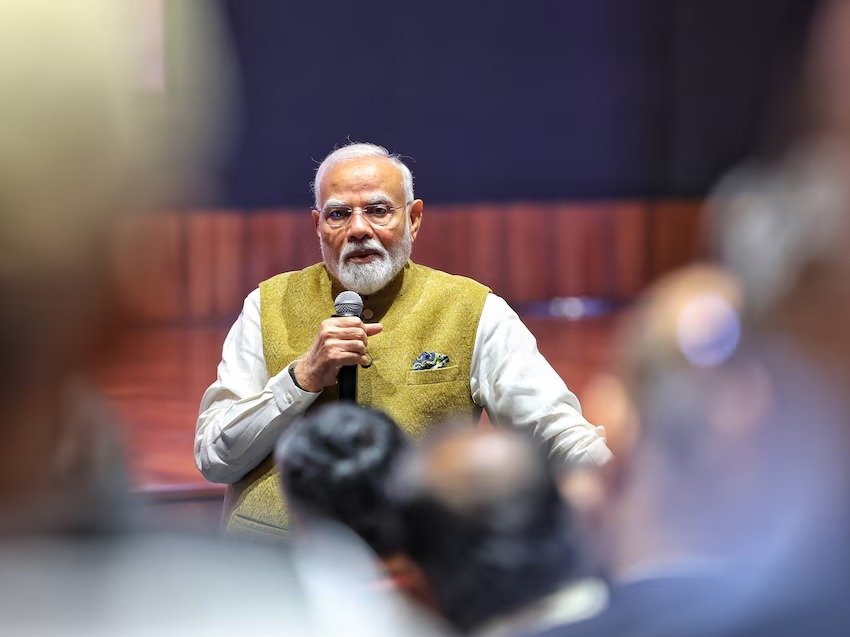
New Delhi, November 2026 : Prime Minister Narendra Modi on Thursday inaugurated the first Shanghai Cooperation Organisation (SCO) Civilisational Dialogue Forum at the historic Purana Qila in New Delhi, calling for stronger cultural cooperation among member countries and describing civilisational dialogue as a powerful means of promoting global peace and enriching human thought.
Addressing ministers, ambassadors, scholars, artists and other delegates from SCO member states, Modi said the forum was much more than a ceremonial gathering. At a time when international discourse is increasingly shaped by conflict and instability, he said, civilisational exchanges could help provide direction to the world.
“Empires may redraw maps, but civilisational dialogues have the power to transform and enrich global thought,” the Prime Minister said, emphasising that cultural connections were among the strongest foundations for lasting peace.
He noted that the forum builds on 25 years of SCO cooperation in areas such as security, the economy and connectivity. Shared cultural experiences, he said, could further strengthen relationships and bring countries closer.
Referring to the historical significance of Purana Qila, which scholars associate with the Mahabharata era, Modi said the cultural performances, Vedic recitations and presentations on Buddhist philosophy at the venue conveyed universal messages of love, unity and human welfare that went beyond national boundaries.
The Prime Minister traced the long history of cultural and intellectual exchanges across Asia and Eurasia. He cited trade links between the Indus Valley Civilisation and Mesopotamia dating back around 5,000 years, as well as the Silk Route networks that connected India, China, Central Asia and other parts of Eurasia.
Travellers and scholars such as Faxian, Xuanzang, Yijing and Kumarajiva, along with centres of learning including Nalanda, Kucha and Dunhuang, played an important role in spreading knowledge, languages and Buddhist texts across regions, he said.
Highlighting examples of this exchange, Modi said India's Panchatantra travelled into Persian and Arabic traditions as Kalila wa Dimna, while the Ramayana influenced literature and artistic traditions across Southeast Asia. Mathematical ideas developed by Brahmagupta reached Baghdad and were further advanced by scholars such as Al-Khwarizmi.
He also referred to the interaction between Central Asian Maqam traditions and Indian Ragas, and the influence of garden designs from Samarkand and Herat on the Charbagh style.
Turning to contemporary opportunities, Modi said 21st-century technology had made cultural connectivity faster and more accessible than ever. Journeys that once took months could now be undertaken in seconds through digital platforms.
He urged SCO countries to use these tools to expand knowledge-sharing and cultural collaboration. He proposed joint initiatives to digitise and translate ancient manuscripts, rare texts and artefacts preserved in museums, libraries and archives. Collaborative research projects, he said, could help young people worldwide explore the heritage of other nations.
Artificial intelligence could also accelerate the translation of literary and intellectual works that remain available in only a limited number of languages, he observed.
The Prime Minister called for joint museum exhibitions, university exchanges, heritage circuits connecting Silk Route and Buddhist sites, cultural festivals and collaborations among artists. He stressed that young people, with their familiarity with technology and digital platforms, should play a central role in carrying the dialogue forward, alongside local artists and artisans.
Linking his vision to the Indian philosophy of Vasudhaiva Kutumbakam—the world is one family—Modi said the pursuit of national welfare was inseparable from the well-being of humanity.
He emphasised that lasting peace depended on mutual trust, harmony, respect for diversity and recognition of shared values.
Concluding with a Vedic invocation calling on people to walk together, speak together and work towards harmony of thought, the Prime Minister congratulated the participants and wished them productive deliberations.