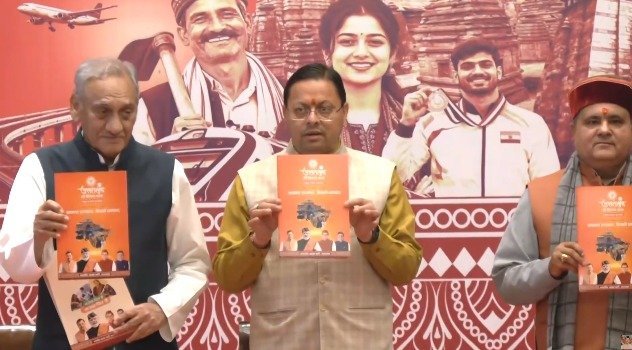
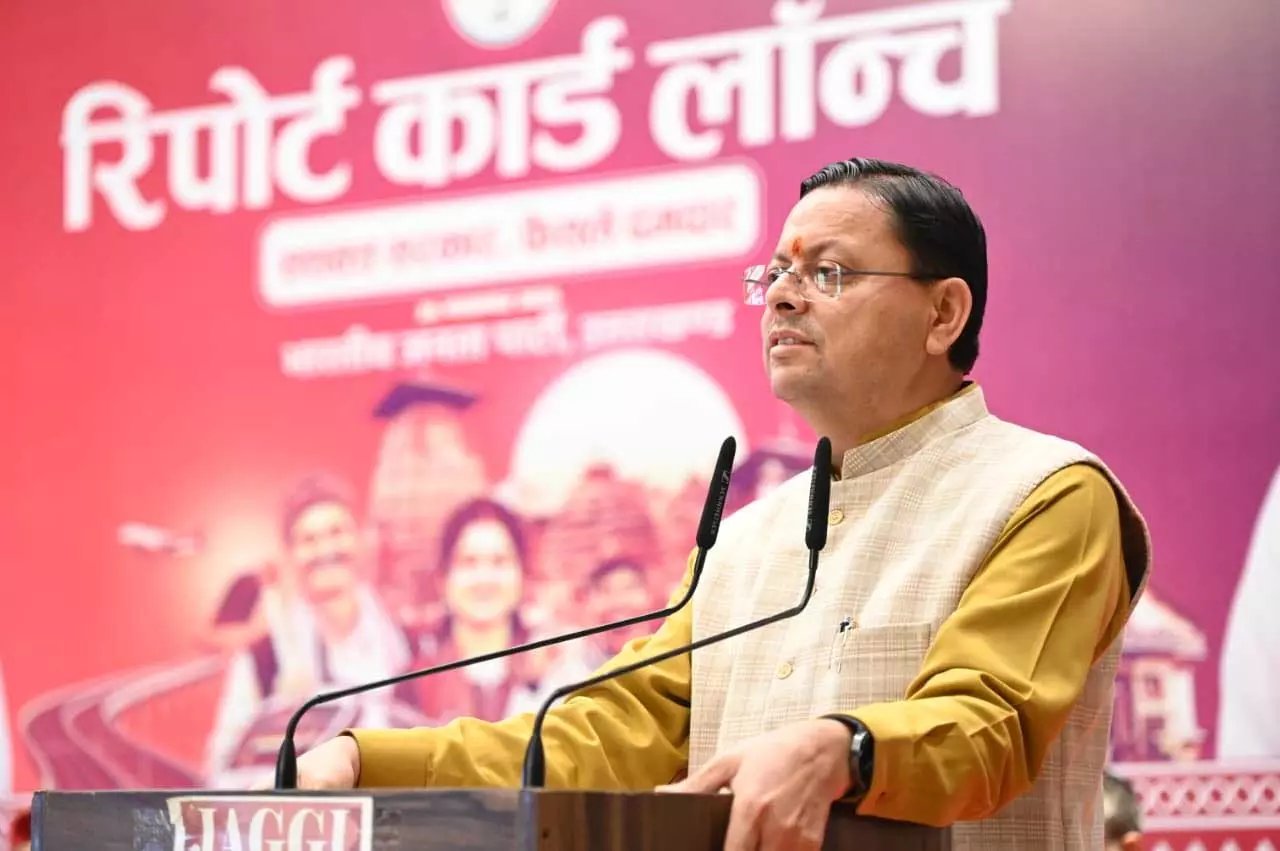
Dehradun, Nov 2026 : Uttarakhand Chief Minister Pushkar Singh Dhami on Thursday released the report card detailing the work undertaken by his government over the past five years. He unveiled the document at a programme organised at a private hotel near the Inter-State Bus Terminal (ISBT) in Dehradun. On the occasion, the Chief Minister presented a detailed account of the initiatives and achievements of the state government across various sectors, including education, healthcare, employment, women's empowerment, farmers' welfare, tourism, industry, investment, energy, infrastructure, law and order, and disaster management.
The Chief Minister said Uttarakhand had made significant progress in various areas of development over the past five years. He said the state government had not limited itself to formulating schemes but had given particular attention to their effective implementation and ensuring that their benefits reached the general public.
He said development activities in the state had gained fresh momentum through the guidance of Prime Minister Narendra Modi and better coordination between the Central and state governments. In line with the vision of a developed India by 2047, the state government's objective was to build a developed, self-reliant and prosperous Uttarakhand.
Better Employment and Education Opportunities for Youth
The Chief Minister said that more than 36,000 young people had been provided government jobs during the past five years.
Under the Chief Minister's Skill Development and Global Employment Scheme, 158 centres are operating to provide training in German and Japanese languages. By October 2026, 106 young people had secured employment abroad through the initiative.
He also said that the process of connecting 11,000 students with free online coaching under the first phase of the Chief Minister's Yuva Bhavishya Nirman Yojana was underway.
Highlighting the achievements in education, Dhami said Uttarakhand had become the first state in the country to implement the National Education Policy (NEP) 2020. More than 21,000 students were being benefited through various scholarship schemes.
He said Uttarakhand had also become the sixth fully literate state in the country. In addition, the country's fifth Science City was being developed in Dehradun.
Women's Empowerment and Social Security Given Priority
The Chief Minister said women in Uttarakhand had been provided 30 per cent horizontal reservation in government jobs. More than 3.10 lakh women in the state had become Lakhpati Didis, reflecting the government's efforts to strengthen their economic position.
Under the Devbhoomi Parivar Yojana, women had been recognised as the heads of their families. Women's self-help groups were also being provided interest-free loans of up to Rs 5 lakh.
Under the Uttarakhand State Rural Livelihood Mission, more than 5.19 lakh women had been organised into groups, resulting in the formation of 70,767 self-help groups.
Dhami said the sale of House of Himalayas, an initiative launched to provide wider market access to local products, had crossed Rs 6 crore.
Under the Nanda Gaura Yojana, eligible families are provided financial assistance of Rs 11,000 on the birth of a girl child and Rs 51,000 when she passes Class 12. By October 2026, more than four lakh girls had benefited from the scheme.
The Chief Minister said approximately 10 lakh beneficiaries were receiving assistance under various social security pension schemes. Around Rs 148 crore was being transferred every month directly into their bank accounts through the Direct Benefit Transfer (DBT) system.
Strengthening Farmers' Incomes and the Rural Economy
Dhami said farmers in the state were being provided interest-free loans of up to Rs 3 lakh.
Under the Pradhan Mantri Kisan Samman Nidhi, more than Rs 3,000 crore had been transferred to the bank accounts of over eight lakh farmers.
The procurement price for mandua (finger millet) had been fixed at Rs 5,200 per quintal. To encourage farming in hilly areas, an allocation of Rs 200 crore had been made for the construction of polyhouses.
The government was also promoting horticulture and high-value crops through the Apple, Kiwi and Dragon Fruit Missions. In addition, the Mahak Kranti initiative was encouraging the cultivation of aromatic crops.
The Chief Minister said local products had received fresh recognition through Geographical Indication (GI) tags.
He added that under the Pradhan Mantri Awas Yojana, more than 53,000 houses had been provided to beneficiaries in urban areas. In rural areas, 39,815 families had received housing benefits since 2022.
Under the Pradhan Mantri Awas Yojana-Gramin, the construction of another 50,000 houses would begin soon.
The Chief Minister's Migration Prevention Scheme had helped more than 6,500 people return to their villages.
Under the Antyodaya Free Gas Refill Scheme, nearly 1.75 lakh families were being provided three free LPG cylinder refills every year.
New Momentum for Investment and Industrial Development
The Chief Minister said investment proposals worth Rs 3.56 lakh crore had been received during the Global Investors Summit held in December 2023. Of these, investment proposals worth more than Rs 1 lakh crore had already been implemented on the ground.
More than 30 new policies had been formulated to encourage investment and promote industrial development in the state.
At Khurpiya Farm, a Smart Industrial City was being developed as part of the Amritsar-Kolkata Industrial Corridor.
Dhami said Uttarakhand had secured the first position in the NITI Aayog Sustainable Development Goals (SDG) Index 2023-24.
The state had been placed in the Top Achievers category in Ease of Doing Business and in the Leaders category for its startup ecosystem.
In the Investment Attraction Index 2026, Uttarakhand had secured the first position among hill and northeastern states.
Expansion of Healthcare Facilities
The Chief Minister said 63.32 lakh Ayushman cards had been issued under the Atal Ayushman Yojana.
By September 2026, more than 17.36 lakh patients had received cashless medical treatment worth over Rs 3,717 crore under the scheme.
Six government medical colleges were operational in the state, three of which had been established during the past five years.
The construction of the satellite centre of the All India Institute of Medical Sciences (AIIMS) at Kichha had reached its final stage.
A helicopter ambulance service was also being operated from AIIMS Rishikesh. Meanwhile, construction of a cancer institute in Haldwani was underway.
The Chief Minister said free facilities for 207 types of pathological tests were also being provided in the state.
Important Decisions and Initiatives for Good Governance
Dhami said Uttarakhand had become the first state in the country after Independence to implement the Uniform Civil Code (UCC). The law came into force in the state on January 27, 2025.
To ensure transparency in recruitment examinations, the state government had implemented a stringent anti-copying law. It provides for life imprisonment and fines of up to Rs 10 crore in serious cases.
The anti-conversion law had also been made stricter, while an anti-riot law had been implemented.
Under the stringent land law, the purchase of agricultural and horticultural land by persons from outside the state had been prohibited in 11 districts of Uttarakhand.
The Chief Minister said more than 13,000 acres of encroached land had been freed through action against illegal occupation.
The Uttarakhand State Minority Education Authority had also been established.
Through the 'Jan-Jan Ki Sarkar, Jan-Jan Ke Dwar' campaign, the government had sought to bring administration and governance closer to the people. Camps would be organised again under the campaign in the coming month.
More than 900 government services were being made available online through the Apuni Sarkar Portal.
Expansion of Road, Rail and Air Connectivity
The Chief Minister said construction of the Delhi-Dehradun Economic Corridor, at an estimated cost of approximately Rs 12,000 crore, had been completed.
Work on the Char Dham All-Weather Road Project was progressing.
Approximately 75 per cent of the Rishikesh-Karnaprayag railway project had been completed. Railway projects worth around Rs 39,000 crore were underway in the state, while 11 railway stations were being modernised.
The foundation stones of the Kedarnath and Hemkund Sahib ropeway projects had been laid.
Dhami said construction of the Dehradun-Mussoorie ropeway was also in progress.
The new terminal at Dehradun Airport had been expanded. For the expansion of Pantnagar Airport, 524.78 acres of land had been transferred.
The number of heli-routes, heliports and helipads in the state had also increased.
The construction of the Ris p ana and Bindal corridors in Dehradun had received approval.
The Chief Minister said that under the three phases of the Pradhan Mantri Gram Sadak Yojana, 2,826 roads had been constructed at a cost of Rs 11,595 crore, creating a road network extending over 21,915 kilometres.
An amount of Rs 1,105 crore had been approved for the Rishikesh Bypass Project.
Vande Bharat train services had also been introduced between Dehradun and Delhi, and Dehradun and Lucknow.
Priority to Tourism and Development of Religious Destinations
The Chief Minister said the state government was encouraging winter pilgrimage tourism along with the traditional Char Dham Yatra.
More than 65 lakh devotees had visited the Char Dham destinations during this year's pilgrimage season. He said the increase in pilgrim movement had directly benefited local residents and the state's economy.
Under the Manaskhand Temple Mala Mission, 48 temples were being developed.
Work was underway on several corridor projects, including the Haridwar-Rishikesh, Vivekananda, Golju, Yamuna and Sharda corridors.
A total of 83 mountain peaks in the state had been opened for mountaineering, while 100 trekking and hiking routes had been identified.
Dhami said a rafting base station was being developed in Rishikesh at a cost of Rs 100 crore.
Policies had also been formulated to promote Uttarakhand as a wedding destination and to encourage yoga and wellness tourism.
More than Rs 500 crore had been allocated for the Kumbh Mela 2027, while Rs 25 crore had been earmarked for the Nanda Devi Raj Jat Yatra.
Progress in Energy and Drinking Water
The Chief Minister said all four units of the 1,000-megawatt Variable Speed Pumped Storage Project at Tehri had started commercial power generation.
The Vyasi Hydroelectric Project was generating 120 megawatts of electricity.
After years of discussions, an agreement had been reached on the Kisa u Dam Project, with six states signing an understanding for its implementation.
Under the Chief Minister's Solar Self-Employment Scheme, 1,132 solar power plants had been installed.
Under the Jal Jeevan Mission, 15,540 of the 16,555 planned schemes had been completed. Drinking water connections had been provided to 14.20 lakh of the state's 14.48 lakh rural households.
Construction of the Saung and Jamrani dam projects was also underway. Work on the Lakhwar Dam Project was progressing rapidly.
Expansion of Urban and Rural Infrastructure
Dhami said the state had received central incentive assistance of Rs 264.50 crore for the development of infrastructure in urban areas.
Of the 7,817 gram panchayats in Uttarakhand, 5,972 had facilities such as panchayat buildings or panchayat secretariats.
The grant amount for the construction of panchayat buildings had been increased from Rs 10 lakh to Rs 20 lakh.
Under the Vibrant Villages Programme, around 200 projects worth Rs 270 crore were being undertaken in 51 villages.
The Chief Minister also said that the compensation provided to families in the event of a death caused by a wildlife attack had been increased to Rs 10 lakh. The state government was also bearing the medical expenses of people injured in such incidents.
Special Focus on Disaster Management, Relief and Rescue Operations
The Chief Minister highlighted the state government's disaster management and rescue efforts.
He cited the successful rescue of 41 workers trapped inside the Silkyara tunnel, who were brought out safely after 17 days, as an example of the government's response during emergencies.
He also referred to the rescue of more than 15,000 people in the Kedarnath region in 2024 and the relief and rescue operations carried out in the Tharali and Harshil areas in August 2025.
For the treatment of landslide-affected areas, the state had received Rs 461 crore from the Central Government. An additional Rs 113.90 crore had been received for disaster mitigation.
Early warning sensors were being installed to monitor potential risks from glacial lakes in the Vasundhara Tal region.
Encouraging Sports and Supporting Athletes
Dhami said Uttarakhand had successfully hosted the 38th National Games, during which athletes from the state won 103 medals.
Work had also been undertaken towards establishing a State Sports University at Gaulapar in Haldwani.
A total of 23 sports academies were operational across eight cities in the state, providing training to 920 athletes every year.
A provision had been made for four per cent horizontal reservation in government services for eligible sportspersons.
Under the Chief Minister's Emerging Player Development Scheme, 3,900 children between the ages of eight and 14 were being provided a monthly scholarship of Rs 1,500.
Development Projects Accelerated Through Centre-State Coordination
The Chief Minister said several development projects in Uttarakhand had gained momentum with the support of the Central Government.
The state's government had received 45.33 acres of land belonging to Hindustan Machine Tools (HMT) at Ranibagh in Haldwani through transfer from the Centre.
He said better coordination between the Central and state governments had helped advance projects related to road, rail and air connectivity, energy, tourism and industrial development.
Relief and Assistance to Families Affected During COVID-19
Dhami said the state government had taken several steps to provide relief to people affected during the first and second waves of the COVID-19 pandemic.
Financial assistance of Rs 200 crore had been provided to the tourism, transport and culture sectors. The medical sector had received assistance of Rs 205 crore, while Rs 118 crore had been allocated for women's self-help groups and self-employment initiatives.
The Chief Minister's Vatsalya Yojana was launched to protect children who had lost their parents during the pandemic and to secure their future.
Important Decisions for Statehood Activists and Agniveers
The Chief Minister said 10 per cent horizontal reservation in government services had been provided to identified statehood activists and their dependants.
The monthly pension for families of statehood activists who had died during the movement had been increased from Rs 3,000 to Rs 5,500.
The pension for activists who had been jailed or injured during the movement had been increased from Rs 6,000 to Rs 7,000 per month. The pension for active participants in the movement had been raised from Rs 4,500 to Rs 5,500 per month.
Free education in schools and colleges had been provided to a maximum of two children of statehood activists. They had also been given free travel facilities on buses operated by the Uttarakhand Transport Corporation.
In addition, an Agniveer Cell had been established for the welfare and support of Agniveers.
Commitment to a Developed and Self-Reliant Uttarakhand
The Chief Minister said the state government's commitment was to transform Uttarakhand into a developed, self-reliant and prosperous state.
He said the government's priority was to ensure that the benefits of development schemes reached the last person in society and that new opportunities were created for young people, women, farmers and weaker sections.
Dhami said the report card reflected the government's efforts across multiple sectors over the past five years, with a focus on development, welfare delivery, social security and strengthening the state's economy.