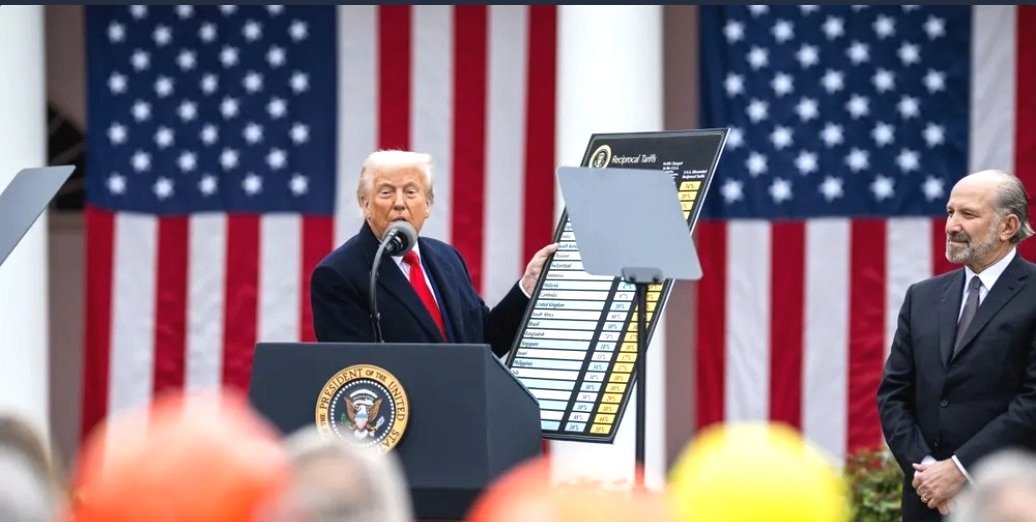
Washington DC/Beijing/Singapore/New Delhi; Novembe2026: As the US President Donald Trump has envisaged new reasons to increase import duties, a new round of tariffs is set to disrupt shipping and trade again.
Some 14 countries are to be hit with import duties imposed under Section 301 of a 1974 trade law that allows the president to act against nation states that are treating US businesses unfairly. Excess capacity tariffs will be 20% on top of the roughly 25% tariffs already imposed by the US administration. The Office of the US Trade Representative (USTR) announced these latest taxes after completing an eight month’s long investigation.
Drewry Shipping's Simon Heaney said: “It was well flagged that Trump wanted to re-build his tariff wall that SCOTUS [Supreme Court of the United States] knocked down, so it’s not a surprise. The midterms haven’t taught this administration much it seems”.
American consumers are, however, set to pick up the bill for tariffs imposed by the United States, as Global Shippers’ Forum (GSF) director James Hookham points out. “Following the 'Liberation Day' tariffs (since declared illegal) the additional costs fell on US importers in the first instance. US Customs and Border Protection (CBP) requires a US-domiciled entity to pay the tariffs and other customs duties and only last month significantly tightened up the rules on this point. So, US-based entities take the cash hit and pay the tariffs. That will again distort the Transpacific and Atlantic trades into the US with importers looking to boost inventories ahead of the imposition of the taxes”.
The USTR representative Jamieson Greer said in a statement on the 25th of this month (November 2026) that the policies and practices of 14 states include “structural excess capacity and production in manufacturing sectors”. He said these practices are unreasonable and place a burden on US commerce and “are thus actionable under Section 301(b) of the Trade Act”.
Hookham noted that: “Some importers may have been successful in negotiating lower prices from their foreign suppliers to compensate but, again, experience is that exporters (notably China) simply found other markets for their products if they were priced out of the US”.
The US National Retail Federation (NRF) said that small businesses, of which 98% of retailers are included, support 13m jobs and “are particularly vulnerable to tariffs”.
According to the NRF, import duties have forced businesses to either shut down or raise prices. “How high the effective tariff rates actually go is hard to predict due to existing agreements and potential roll-backs, but I suspect this will cause the usual mayhem i.e., a frontloading demand surge ahead of deadlines, a freight rate spike for US imports and more general business uncertainty. Sadly, I think this pattern is here to stay for the duration of this administration”, said Heaney. One estimate on the costs from the NRF was that these tariffs could cost the average household $3,800, “squeezing budgets and reshaping spending priorities”.
Nevertheless, after the failure of the Liberation Day tariffs, the Trump administration introduced the forced labour tariffs, which are now being challenged in the US Court for International Trade, with the expectation that the court will again declare these tariffs illegal. “The verdict seems to be that tariffs back-fire inflating prices in the importing economy and encouraging suppliers to seek other markets. It may also be recalled that one definition of insanity is doing the same thing but expecting different results”, said Hookham.
More practically, GSF has offered the following advice to shippers wondering if their goods are affected:
·Wait for the Executive Order to be published. It may contain the listing of tariff rates by the HS Customs Code. There is talk of exceptions and carve-outs so don't rely on the announcements or the social media messages.
·If not the Executive Order, then the notice of Rulemaking in the Federal Register will contain this detail. Apart from exceptions and conditions, there may be additional paperwork required to be submitted alongside Customs declarations. It will be specified here.
·And the actual date of implementation is notified in advance by USCBP to confirm it has updated the US Automated Customs Environment (ACE) with the new tariff rates and is ready to start collecting the applicable amounts as part of routine Customs declarations. This notice will also describe arrangements for goods that are still in transit on the effective date.
The USTR listed the 14 economies covered by the Excess Capacity Tariffs as: China, the European Union, Singapore, Switzerland, Indonesia, Malaysia, Cambodia, Thailand, South Korea, Vietnam, Taiwan, Bangladesh, Japan, and India. Further deliberations are continuing on Mexico and Norway, said the USTR.
In its latest analysis, Review of Maritime Transport 2006, the UNCTAD has predicted zero growth in seaborne trade for 2026, down from 1.9% growth last year and before a projected recovery to 3.2% in 2027. Longer voyages, however, are likely to boost ton-miles by 1.5%. However, UNCTAD’s estimates were made before Trump announced his latest round of tariffs against 14 trading partners on Wednesday (25th November 2026). This move puzzled many analysts since his earlier tariffs had proved very unpopular with many Americans and have been cited as one of the factors leading to the remarkable Republican downfall.
The zero-growth projected for this year was the result of disruptions to major shipping routes and chokepoints, as well as wider trade uncertainty. The Review highlighted the Strait of Hormuz where trade in gross tons plunged by about 95% in March, but noted also hostilities in the Red Sea and its impact on the Suez Canal, forcing many ships on the longer voyage round the Cape of Good Hope. UNCTAD’s analysts also cited the Black Sea security risks and restrictions and changing traffic patterns at the Panama Canal.
Team Maverick.