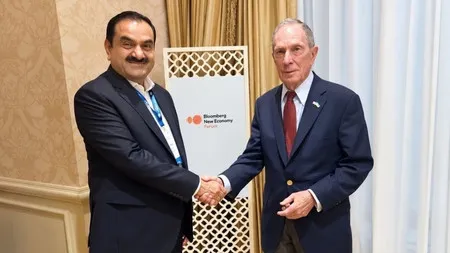
Ahmedabad, Oct 2026 : Adani Group Chairman Gautam Adani on Wednesday emphasised the importance of infrastructure development, clean energy, transparent governance and community-focused urban renewal, saying leadership should be judged by its contribution to expanding humanity’s future possibilities.
In a LinkedIn post reflecting on his meeting with Bloomberg co-founder Michael Bloomberg at the Bloomberg New Economy Forum in New Delhi, Adani said the questions raised during their interaction highlighted the importance of combining physical infrastructure with strong institutions and reliable data.
“Leadership is not measured by the milestones we celebrate today, but by the commitment to expand what humanity can achieve tomorrow, and very few embody that better than Bloomberg Co-founder Michael Bloomberg,” Adani wrote.
He argued that nations required two forms of infrastructure to sustain long-term development. The first was visible physical infrastructure, including ports, power transmission networks, green hydrogen plants, large-scale computing facilities and public transport systems.
The second, he said, was less visible but equally important, comprising trustworthy data, accountable institutions and governance systems focused on implementation rather than announcements.
According to Adani, both forms of infrastructure must develop together to support sustainable economic growth.
Balancing Economic Growth With Decarbonisation
Reflecting on the differing priorities of emerging economies and mature capital markets, Adani said development strategies were shaped by the realities each faced.
For an emerging economy such as India, the immediate priority was to expand reliable electricity supply, industrial capacity and digital access to improve economic security for hundreds of millions of people.
In mature capital markets, he observed, discussions often focused more heavily on the pace of decarbonisation and regulatory alignment.
Despite these differences, Adani said both perspectives shared the conviction that clean energy and affordability must advance together.
“Decarbonisation cannot be an ideological decree that prices out ordinary citizens, shuts down factories or stalls the Global South,” he said.
He added that the energy transition would face serious challenges if green power remained unaffordable or unreliable for small businesses in Gujarat and households in Uttar Pradesh.
At the same time, Adani cautioned against continued dependence on traditional energy systems, pointing to the growing risks associated with climate volatility.
He called for coordinated efforts involving capital, public policy and implementation to reduce the additional cost of clean energy, making it a more affordable and practical choice for consumers and businesses.
The objective, he said, should be to ensure that cleaner energy becomes not only environmentally preferable but also economically competitive.
Bloomberg's Engagement With India
Adani also praised Michael Bloomberg's engagement with India, referring to his remarks at the Bloomberg New Economy Forum on the country's progress in artificial intelligence, advanced manufacturing and green infrastructure.
Adani said Bloomberg's observations reflected a longstanding engagement with the Indian economy rather than simply comments delivered at an international forum.
He noted that Bloomberg had maintained an operational presence in India for three decades, alongside nearly two decades of philanthropic engagement.
The interaction, according to Adani, illustrated the importance of sustained partnerships between businesses, institutions and governments in addressing development challenges.
Dharavi Redevelopment as a Test Case
A significant part of their discussion focused on the redevelopment of Dharavi in Mumbai, a densely populated settlement with an extensive network of small businesses, family enterprises and community-based economic activities.
Adani said Bloomberg's experience as mayor of New York offered useful perspectives on how municipal data, effective administration and disciplined implementation could improve conditions in densely populated urban areas.
However, he stressed that Dharavi's redevelopment could not be treated merely as a real estate project.
“Dharavi cannot be approached as a real estate parcel. It is a vital, self-sustaining ecosystem of micro-entrepreneurs, multigenerational households, and relentless human grit,” he said.
Adani argued that the project's success should be measured by improvements in residents' quality of life rather than simply by the amount of construction completed or the square footage developed.
He identified climate-resilient housing, modern sanitation, dependable electricity and the protection of livelihoods as essential elements of meaningful urban renewal.
The redevelopment, he said, should preserve the economic and social networks that support Dharavi's residents while improving their access to essential services and better living conditions.
Adani added that combining engineering expertise with community trust could help establish Dharavi as a benchmark for urban regeneration in developing economies.
Four Pillars of Nation-Building
Concluding his reflections, Adani identified four essential elements for successful nation-building: patient capital, physical execution, transparent governance and capable local leadership.
“True nation-building demands four non-negotiable forces, namely patient capital, physical execution, transparent governance and capable local leadership. None can substitute for another,” he said.
His remarks underscored the need to integrate investment, infrastructure delivery, institutional accountability and local participation to achieve sustainable development.
From the transition to clean energy to the redevelopment of urban communities, Adani's observations highlighted the importance of balancing economic growth with affordability, environmental responsibility and social inclusion.
The central message of his interaction with Bloomberg was that lasting progress depends not only on the infrastructure nations build, but also on the quality of governance and the opportunities created for their people.
(Disclaimer :The content of this article is sourced from a news agency and has not been edited by the Mavericknews30 team.)