Chief Minister Dr. Mohan Yadav said that Indian democracy has remained strong despite the 1975 Emergency and restrictions on the press. From the Shah Bano case to the abrogation of Article 370 in Jammu and Kashmir, certain individuals and political parties have hurt the Constitution due to their distorted mindset. Today, the country accords the Constitution the respect and importance it deserves. Prime Minister Shri Narendra Modi initiated the tradition of observing November 26 as Constitution Gaurav Diwas. The day offers an opportunity to reflect on the Constitution’s journey over nearly eight decades. Today, India is the world's youngest and largest strong democracy, and its unique strengths continue to amaze the world. While several countries have witnessed changes of power through violence and the use of arms, democracy in India remains enduring, guided by the sacred document of the Constitution. It inspires us to follow the democratic path.
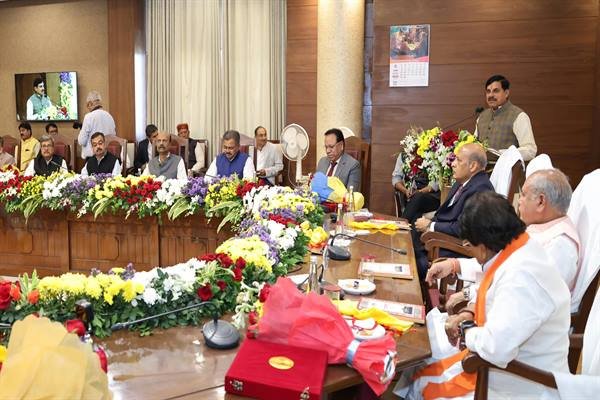
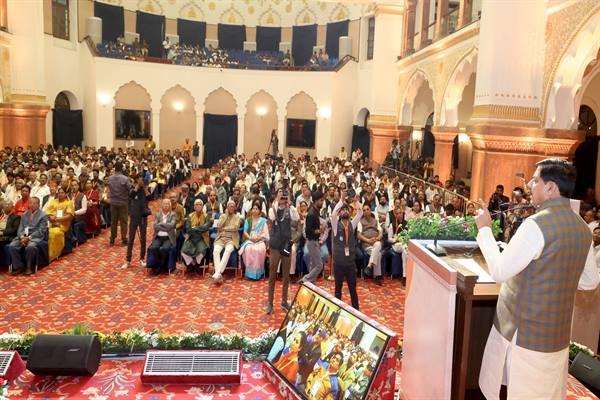
Chief Minister Dr. Yadav addressed the Prabuddhjan Sangoshthi (Intellectuals’ Seminar) organised at the Kushabhau Thakre International Convention Centre on Samvidhan Gaurav Diwas. Union Minister for Tourism and Culture Shri Gajendra Singh Shekhawat and other dignitaries also addressed the seminar. Before the programme, the Chief Minister and the Union Minister visited an exhibition organised on the premises. Organisation General Secretary Shri Chandrashekhar was especially present. The dignitaries on the dais were welcomed.
Chief Minister Dr. Yadav said that elections are held every five years through a democratic process, giving citizens the opportunity to elect their representatives. The country attained independence after a long struggle. The Constitution lays down the principles governing the functioning of every government. Eminent personalities from Madhya Pradesh also made notable contributions to its making. During the deliberations on the country's name after Independence, the Central India region was recognised as Madhya Bharat Province. This strengthened the case for adopting the name ‘Bharat’ for the nation.
Chief Minister Dr. Yadav said that Rajkumari Amrit Kaur was among the first to support a uniform law for all citizens in the country. The Constitution speaks of equality, which, in a way, reflected support for the Uniform Civil Code (UCC). Instead of recognising Vikram Samvat, a new national calendar based on the Shaka Samvat was adopted, even though its dates and months follow a pattern similar to Vikram Samvat. Successive governments did not promote the Vikram Samvat introduced by Samrat Vikramaditya. He said that numerous brave revolutionaries, including Sardar Bhagat Singh and Chandrashekhar Azad, sacrificed their lives to protect the country's freedom, Constitution and democracy. This legacy of sacrifice dates back a thousand years, to Prithviraj Chauhan. The struggles and sacrifices of freedom fighters have made it possible for even a person from the humblest background to aspire to the highest office in the country. The Constitution has empowered citizens. Prime Minister Shri Narendra Modi is leading the government for the third consecutive term and is among the country's longest-serving leaders.
Union Minister for Culture and Tourism Shri Gajendra Singh Shekhawat said that the Constitution has shown us the path of justice, equality, unity and fraternity. The occasion also offers an

Union Minister Shri Shekhawat said that Dr. Ambedkar believed that the light of development must reach the last person in society. Under the leadership of Prime Minister Shri Narendra Modi, efforts are being made to translate Babasaheb's ideals into reality through the spirit of Sabka Saath, Sabka Vikas and Sabka Vishwas. Prime Minister Shri Modi regards the Constitution as the guiding force for India's unity, justice and equality, and an integral part of the lives of millions of Indians. He said that Babasaheb strongly opposed reservation based on religion and identity, and advocated reservation on economic, social and educational grounds. The progress of society can be assessed by looking at the status of women. The government is working to ensure rights and empowerment for women and girls. Babasaheb had advocated equal rights for women in matters of inheritance, marriage and divorce. India stands at the threshold of becoming a developed nation by 2047. He urged everyone to awaken a sense of duty and contribute to building a developed India for future generations.
Former High Court Judge Shri Rohit Arya said that the Constituent Assembly adopted the Constitution of India on November 26, 1949, and it came into force on January 26, 1950. The occasion reminds citizens of their rights and duties. The Constitution has guaranteed them equality, justice and dignity.
State BJP President Shri Hemant Khandelwal said that Babasaheb Dr. Bhimrao Ambedkar gifted the people of the country the Constitution, a sacred document. Prime Minister Shri Narendra Modi initiated the observance of Constitution Gaurav Diwas on November 26, 2015. Madhya Pradesh is home to Babasaheb's birthplace in Mhow. Despite facing numerous hardships throughout his life, he transformed his suffering into a source of inspiration. In 1975, the then government had strangled the Constitution. At the initiative of Prime Minister Shri Modi, all five places associated with Babasaheb's life have been developed as Panchteerth.
Minister of State for Backwards Classes and Minority Welfare Smt. Krishna Gaur, Bhopal Mayor Smt. Malti Rai, MLAs Shri Rameshwar Sharma and Shri Bhagwandas Sabnani, along with several public representatives and intellectuals, were present at the programme.