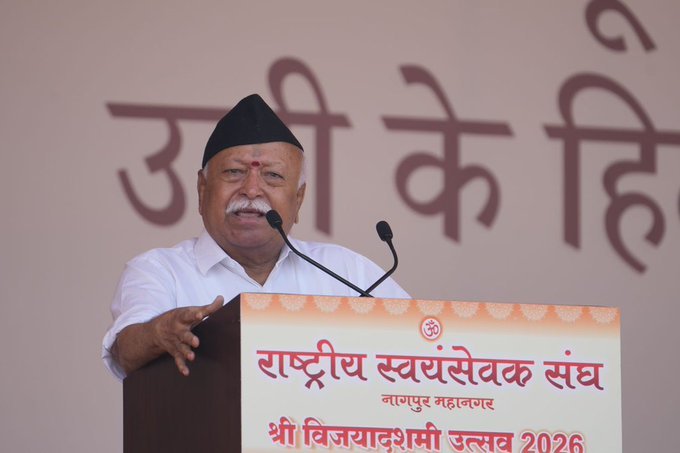
RSS chief says attempts to ‘dismantle’ India will fail, stresses social harmony, constitutional conduct, youth development and self-reliance at centenary-year Vijayadashami rally in Nagpur
Nagpur, October 2026 : Rashtriya Swayamsevak Sangh (RSS) chief Mohan Bhagwat on Tuesday asserted that attempts to weaken or “dismantle” India would not succeed, emphasising that the country’s civilisational heritage, cultural values and spirit of unity could help it emerge as a leading global power and contribute to resolving complex international challenges.
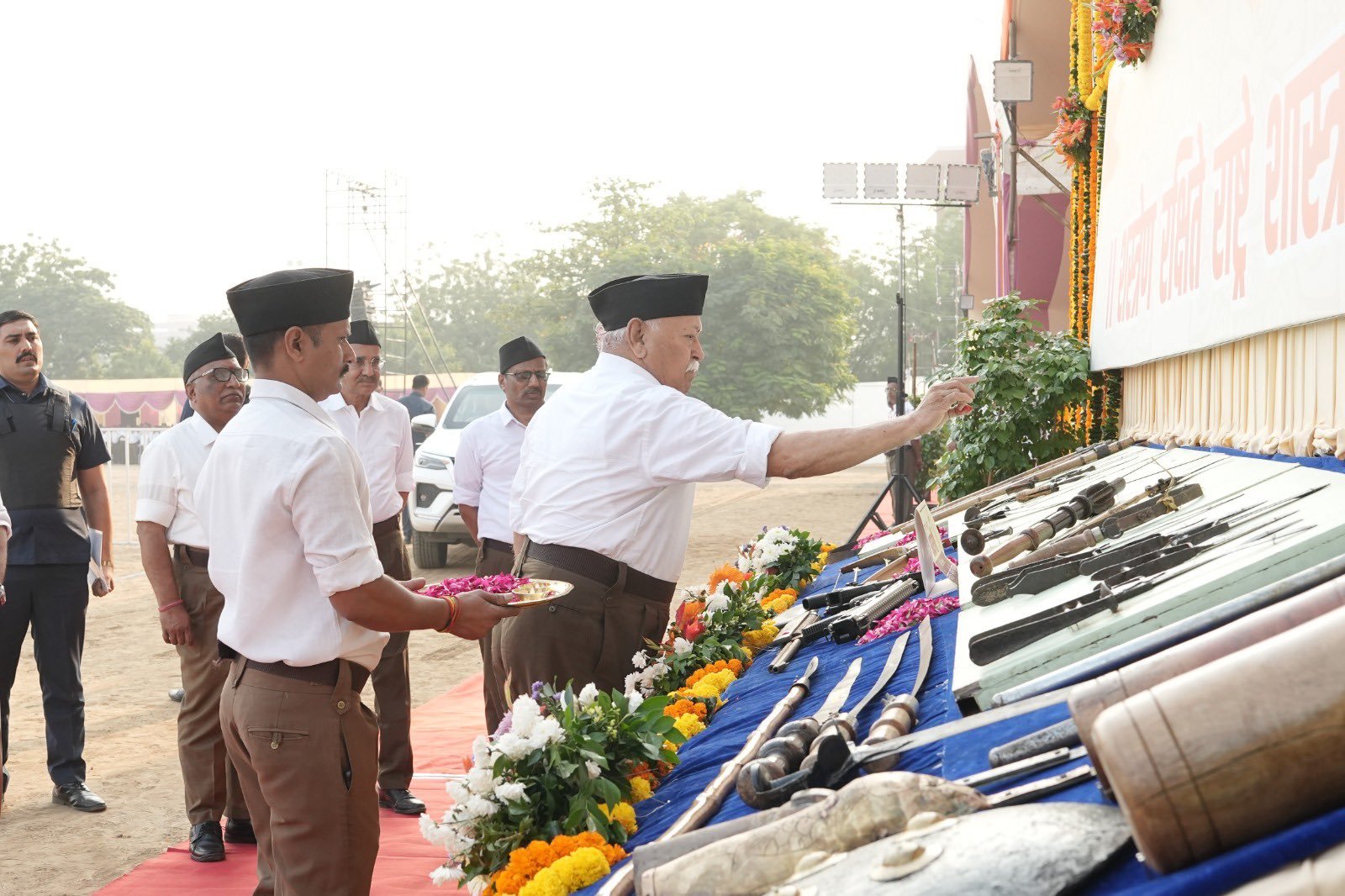
Addressing the Sangh’s annual Vijayadashami rally at Reshimbagh ground in Nagpur, Bhagwat called for strengthening India’s social fabric, promoting harmony among communities and encouraging citizens to take greater responsibility for national development. His address coincided with the RSS completing 100 years since its foundation on Vijayadashami in 1925 and observing its 101st foundation day.
The RSS chief said India’s progress had attracted global attention, with countries increasingly looking towards its traditional wisdom for answers to challenges involving environmental degradation, social diversity, weakening family structures and conflicts arising from the pursuit of power.
“India is their main target because India is progressing. These forces know that they cannot disrupt India the way it has moved ahead with decisive policies in the last few decades. They are trying to dismantle India and the Sangh,” Bhagwat said, alleging that some people within the country, including political leaders, were supporting such efforts.
He also cautioned against the assumption that a change of government alone could resolve the country’s problems.
“They said that a regime change would change the situation, but it did not happen. It did not happen earlier, and it will not happen today either,” he said, arguing that lasting change required broader social participation and sustained efforts beyond electoral politics.
Constitution and civilisational identity
Bhagwat underlined the importance of India’s civilisational consciousness, describing the Preamble to the Constitution as an expression of the country’s collective identity and emotional bond.
“The Constitution’s Preamble serves as our emotional bond. It is this very bond that has maintained the country as a single nation since ancient times, despite vast diversity,” he said.
According to Bhagwat, India’s ancestors understood the importance of this underlying unity, while periods of forgetfulness and social fragmentation had contributed to the country’s historical decline and centuries of foreign rule.
He said India eventually regained its freedom through the sacrifices and struggles of numerous national leaders and freedom fighters. Preserving that achievement, he added, required citizens to understand, strengthen and practise the values underpinning national unity in their everyday lives.
Bhagwat maintained that India’s diversity of geography, languages, castes, regions, traditions and food habits should be respected rather than treated as an obstacle to national cohesion.
He called for a common value system that could accommodate these differences while enabling people to move forward together. India’s traditional philosophy, he said, offered a framework for maintaining unity without erasing diversity.
India’s role in addressing global challenges
Reflecting on the changing international environment, Bhagwat said economically prosperous and technologically advanced countries were confronting problems that could not necessarily be resolved through material progress alone.
He referred to environmental damage, difficulties in managing diversity, the weakening of family relationships and destruction caused by power struggles as some of the major concerns confronting societies worldwide.
He argued that India’s cultural and philosophical traditions could offer perspectives on addressing these issues, adding that the international community was paying increasing attention to the country’s experience and ideas.
Bhagwat said India’s growing global role should be accompanied by a stronger commitment to its own civilisational values, social responsibilities and national self-reliance.
He also urged citizens to reject narratives that divide society into opposing groups and instead work towards cooperation, mutual respect and a shared national purpose.
Social harmony and individual responsibility
Outlining priorities for the RSS after its centenary year, Bhagwat emphasised Samajik Samrasata (social harmony), Vyakti Nirman (individual character building) and collective responsibility.
He said social transformation could not depend exclusively on the government or the state machinery. Individuals, families and communities had an equally important role in strengthening society and addressing its challenges.
Bhagwat called for greater commitment to character development and social cohesion, stressing that citizens must work together despite ideological, cultural and regional differences.
He also urged people to promote Swadeshi, or self-reliance, as part of a broader effort to strengthen India’s economic and social foundations.
Protests must remain within constitutional limits
Referring to tensions and unrest in different parts of the world, Bhagwat said India was facing challenges from forces that, in his assessment, opposed established institutions, cultural values and social order. He cited developments in France, Albania, Bangladesh and Nepal while discussing the wider challenges confronting societies.
Describing what he characterised as a wave of opposition to established norms and human values, he said even developed nations were affected by such developments.
However, he acknowledged that India, as a large and developing country, continued to face genuine public grievances that could lead to protests.
Bhagwat said demonstrations were an integral part of democracy but cautioned that they should focus on addressing grievances rather than creating disorder or deepening divisions.
“Whether it is protesting groups, authorities enforcing law and order, or political leaders, no actions should create conflict, hatred, bitterness or division within our united society,” he said.
He added that regardless of the intensity of public emotions, the actions of protesters, officials and political leaders should remain within the boundaries of the Constitution, the law and civil decorum.
His remarks came amid protests over alleged irregularities in the Special Intensive Revision (SIR) of electoral rolls and demands for accountability from Chief Election Commissioner Gyanesh Kumar. They also followed senior Supreme Court lawyer Prashant Bhushan’s observation that protests in Delhi over the SIR exercise had become “really a fight for regime change”.
Youth development and national strength
Bhagwat stressed that India’s future depended substantially on the health, discipline, character and preparedness of its younger generation.
He called for ensuring that young people were physically fit, mentally strong and equipped to contribute meaningfully to society. Describing the youth as a key component of India’s demographic dividend, he said their development was essential for building a capable and resilient nation.
He urged citizens to make sustained efforts towards national development, arguing that the responsibilities of the present generation demanded dedication comparable to, and in some respects greater than, the sacrifices made during the freedom struggle.
Concluding his broader message, Bhagwat reiterated the importance of unity, social harmony, constitutional conduct and self-reliance. He called on Indians to draw upon their civilisational heritage while addressing contemporary challenges through collective action.
The centenary-year Vijayadashami address provided an occasion for the RSS chief to reflect on the organisation’s journey since 1925 and outline its emphasis on individual development, social cohesion and national identity in the years ahead.