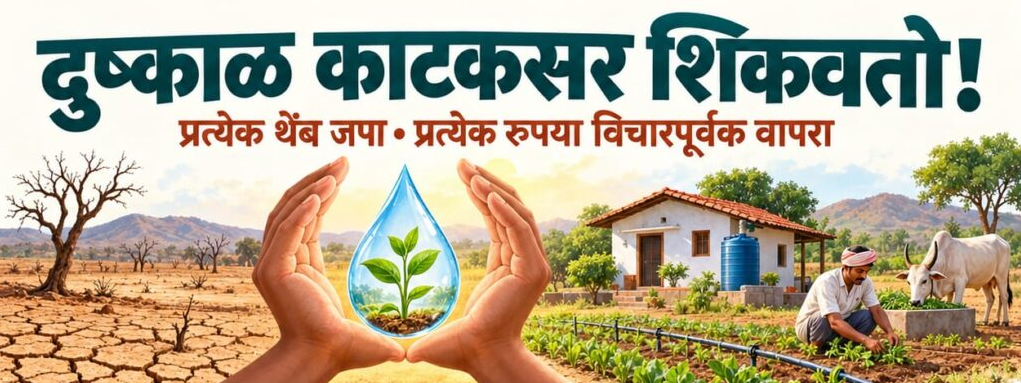
October 2026 : Drought is not merely a matter of receiving less rainfall. It has several dimensions, including water scarcity, a decline in agricultural income, shortage of fodder for livestock, threats to the survival of animals and birds, rising household expenses, and an impact on employment opportunities. People in Marathwada, Vidarbha and some adjoining regions are repeatedly forced to bear the brunt of drought. At such times, alongside the relief measures undertaken by the government, citizens must also use available resources judiciously. An observation passed down by previous generations remains relevant even today: “Drought teaches everyone the importance of frugality!” However, it is equally important to understand how this frugality should be practised.
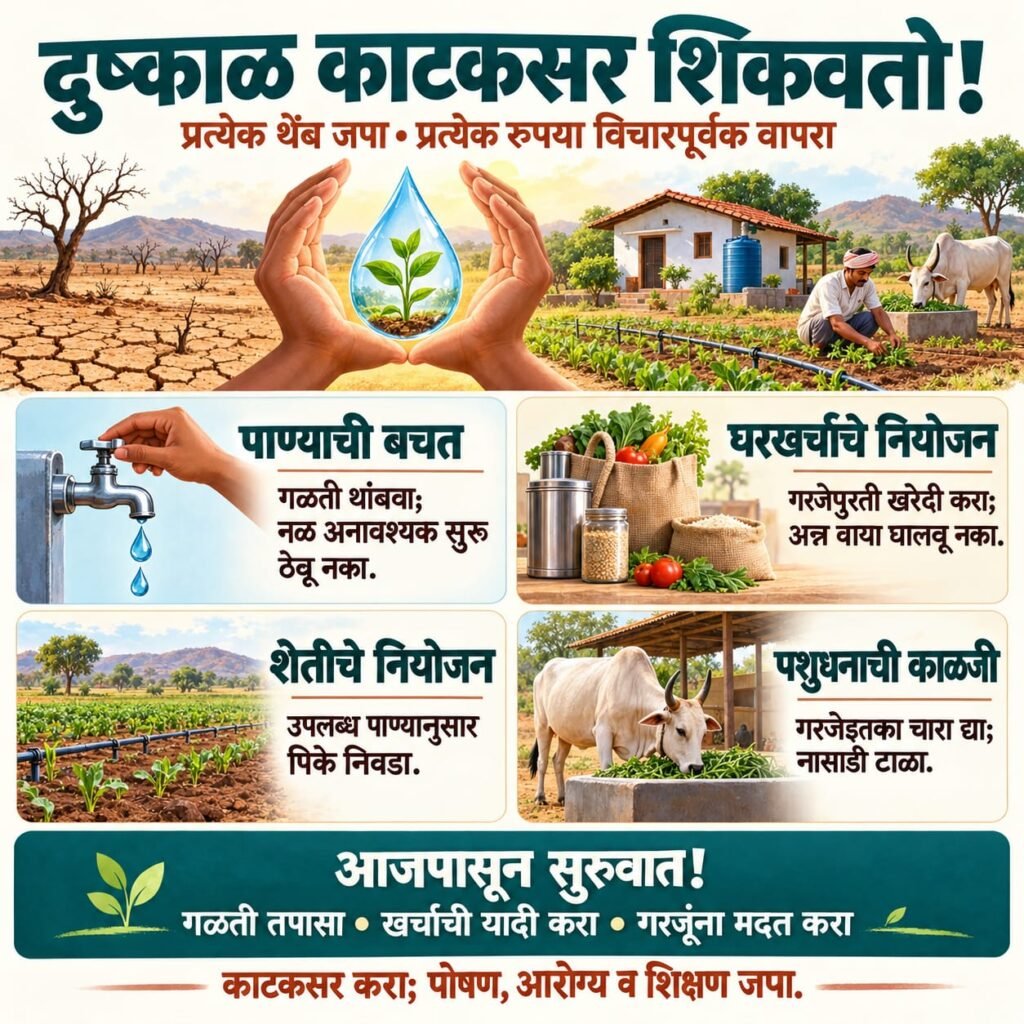
Avoid Water Wastage and Plan Carefully
Every drop of water matters during a drought. Each of us must recognise the possibility of a severe water shortage. The first thought we need to discard is the question, “What difference will it make if I use less water?”
Leaking taps at home should be repaired immediately. Taps should not be left running while brushing teeth, shaving or washing utensils. A bucket should be used instead of a shower for bathing, and a bucket should be preferred over a hosepipe for washing vehicles. Water used to wash vegetables can be reused for watering plants. Household water tanks should have automatic controls or arrangements to prevent overflow.
Give Priority to Drinking Water
Drinking water and water required for cooking should be given priority and reserved accordingly. Available water should be allocated according to necessity for drinking, cooking, cleaning and other household activities. Drinking water must be stored in clean, covered containers. Even during water scarcity, there should be no compromise on the safety of drinking water.
Keep a Watch on Public Water Supply
In villages, leakages from public taps must be stopped, water-supply schedules should be followed, and equitable distribution of water must be ensured. Drip irrigation should be used for farming, while measures such as farm ponds, stream bunds, check dams and groundwater recharge should be undertaken according to local conditions.
Coordination with gram panchayats and the administration is necessary to prioritise water conservation works under employment guarantee schemes. Planning for the work required to recharge groundwater during the next monsoon must begin now. Initiatives such as constructing check dams and small bunds, and deepening and widening streams, need to be taken up proactively.
The present drought also reminds us that every household in Marathwada, whether its roof is made of tin sheets or traditional tiles, should make arrangements to ensure that rainwater from the roof percolates into the ground. Everyone must recognise the importance of making rainwater harvesting a necessary practice at every home. Such small measures are particularly important for groundwater recharge.
Agriculture Bears the Greatest Impact of Drought
Our entire economy is closely linked to agriculture, while the rural economy depends on agricultural production. Therefore, we must plan on the assumption that drought may occur and assess available water, soil moisture, crop conditions and likely income.
Before the next sowing season, farmers should consult the Agriculture Department and choose crops that require less water and are suited to local climatic conditions. When water availability is uncertain, the potential losses should be considered before making large investments in water-intensive crops.
Wherever possible, drip or sprinkler irrigation should be adopted. Drip irrigation delivers water directly to the roots of crops. Irrigation should be scheduled for suitable times, such as early morning or evening, and leaks in farm pipes, valves and joints must be repaired.
Crop residues or suitable mulch should be used to retain moisture in the soil. Excessive irrigation beyond the actual requirement should be avoided.
Soil Testing and Fodder Availability
Instead of applying fertilisers and pesticides based on guesswork, farmers should use them according to soil-test results, crop conditions and the advice of agricultural experts.
Costs can be reduced by purchasing seeds, fertilisers and crop-protection products collectively, sharing agricultural machinery and pooling expenses through farmers’ groups. Information about crop insurance, government assistance and employment schemes should be obtained from authorised agencies.
Livestock and fodder must also be conserved. Animals are an important asset for rural families. Available fodder should be measured and used carefully, with arrangements made to prevent wastage. Safe crop residues should be stored properly, and fodder production should be planned wherever possible.
Livestock must be provided with clean drinking water regularly. Sudden changes in their diet should be avoided, and their care should be guided by veterinary advice. If fodder scarcity becomes severe, people should contact the local administration to enquire about cattle camps and other government facilities.
Employment, Savings and Collective Assistance
If agricultural income declines, people should approach the gram panchayat and employment guarantee authorities to obtain information about available work. Eligible individuals should apply for employment and relief schemes.
Households should plan the use of their available foodgrain stocks. During financial difficulties, they should explore official assistance and other available options rather than resorting to loans carrying high interest rates.
Drought is not merely a farmers’ problem; it affects the entire rural economy. Financially well-off citizens, social organisations, traders and charitable groups should support needy families by providing foodgrains, educational materials or essential commodities. Such assistance should be coordinated with the local administration and provided in a manner that respects the dignity of beneficiaries.
Plan Household Expenses and Avoid Unnecessary Spending
When income is likely to decline during a drought, families should establish priorities for their monthly expenditure. Money for foodgrains, medicines, education, electricity and essential travel should be set aside first.
Unnecessary purchases, expensive items, ostentatious spending and loans that households cannot afford should be avoided. Before going to the market, people should prepare a list of essential items. It is useful to shop economically and enter the market with a clear understanding that only necessary purchases should be made.
Planning weekly vegetable purchases and monthly grocery shopping can help reduce unnecessary expenditure.
During this year's Diwali, families can cut down on spending on firecrackers, expensive clothes, decorative items and unnecessary gifts. Festivals can be enjoyed in a simple manner as well. The money saved today may prove useful in dealing with difficulties over the coming months.
However, while practising frugality, families must not neglect nutrition, health or children's education.
Frugality Is Our Collective Strength
Although preventing drought completely may not be within everyone's control, each person can do something to reduce its impact. This includes adopting cooperative practices such as group farming, using public water sources responsibly, conserving water at home, planning agricultural expenditure, caring for livestock, curbing unnecessary purchases and helping those in need.
Understanding the circumstances of our neighbours during festivals and offering whatever assistance is possible is also a social responsibility. Festivals can be celebrated collectively during such difficult times. Communities can come together to observe celebrations simply and meaningfully. Instead of waiting for someone else to take the initiative, people must step forward and organise different activities in villages.
Drought Can Help Build a Better Future
Drought-prone regions have faced such crises many times in the past. Yet those who had the means and willingness to help extended a helping hand to others. Ordinary people can come together and accomplish extraordinary things during difficult times.
Villages can explore several measures, from organising community weddings to celebrating festivals collectively. In fact, nature may also be presenting us with an opportunity through drought to reflect on how such circumstances can be prevented from recurring in the future.
Every village in Marathwada should strive to become water-secure. Water audits should be conducted in every village, and the necessary measures to improve water availability must be identified and implemented. The present drought should serve as an opportunity for serious reflection and planning.
The government makes efforts to look after everyone, but if villages become self-reliant, they can provide additional support to the administration during a crisis.
Therefore, from reducing expenditure to conserving water, every citizen has a duty to contribute to overcoming drought. As the saying goes, “Drop by drop, a lake is formed.” Every small effort can contribute to a larger collective response to drought.