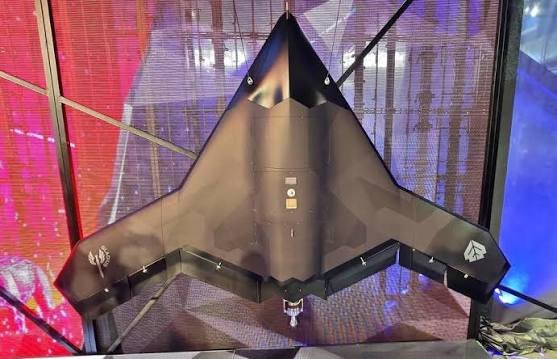
Warshaw; September 2026: WB Group - Poland’s largest private defence-industry entity, providing advanced technological solutions in support of national and allied armed forces, has unleashed a new kamikaze drone fondly called - Warmate 30, with a strike range of more than 250 kilometres. The Warmate 30, which is a new attack drone equipped with a jet engine and carrying a warhead weighing up to 30 kg.
It is a completely different weapon system from the Warmate 3, which is already in service with South Korea, differing in shape, size class and mission. WB Group presented the vessel for the first time at the MSPO 2026 exhibition in Kielce, Poland.
The drone was developed under the Gladius 2 program. It is designed to accurately strike high-value targets at long distances, including targets that remain exposed for only a short time. WB Group is a leading private Polish defence contractor, whose products include the FLYEYE reconnaissance drone, the WARMATE loitering drone and the GLADIUS unmanned system.
The Warmate 3 and the new Warmate 30 clearly differ in size, propulsion and mission. The most significant change lies in the fact that the introduction of a long-range attack drone broadens the product range: from a small loiterer carried by an individual soldier, we move to a long-range and deep-penetrating strike weapon, equipped with a jet engine. This reflects the rapid evolution of drones in modern warfare, as they are transformed from simple tactical weapons to long-range precision strike means.
The Warmate 30 differs significantly from the smaller Warmate 3. It adopts a blended wing-body design and a structure that reduces radar and thermal signature. It uses a Polish-made turbojet for propulsion, which means that a rocket booster is required for launch.
Above all, it has the ability to carry a warhead weighing up to 30 kilograms, allowing it to hit much larger and more distant targets compared to smaller systems. Its maximum speed exceeds 450 kilometres per hour, while its cruising speed exceeds 150 kilometres per hour.
With a range of over 250 kilometres and the ability to stay airborne for more than an hour, the Warmate 30 is not just a scaled-up version of the Warmate 3. It implements the logic of a deep strike, engaging targets at a much greater distance.
The Warmate 30 was built bigger and faster as the loitering mission scope expanded from the area around the front line to the enemy’s rear. While existing small systems attack tactical targets such as tanks and fortified positions, the Warmate 30 is designed to engage high-value, heavily protected targets from long range—such as command centres, air defence networks, and logistics support facilities.
For this reason, a jet engine was chosen. The system reaches target areas faster than slower propeller-driven drones and is designed to react effectively against moving targets, such as mobile air defence systems and command vehicles. The combination of low radar signature and high approach speed minimises the risk of detection and interception by enemy air defences.
The Warmate 30 is designed to operate within a reconnaissance and strike system, rather than as a stand-alone drone. Through the Gladius program, the Polish military is unifying reconnaissance, command, and precision strike functions on the battlefield into a single network, connecting all unmanned systems to the Polish military’s TOPAZ battlefield management system. Once a reconnaissance drone locates a target, the coordinates are transmitted through the command system to the strike vehicle.
Preparation time has also been reduced, allowing for rapid strikes on distant targets. The Warmate 30 can be brought into combat readiness within five minutes and launched from either container-type launchers or the existing Gladius series launchers. The canister-launch method was developed for use on both sea platforms and land.
Poland is expanding its drone force on a large scale this year. Under a contract signed in May this year (2026), the country will acquire around 190 FLYEYE reconnaissance drone systems and more than 400 Warmate loitering munitions systems, in addition to 12 artillery-grade units under the Gladius program. With these means, the Polish army plans to acquire the ability to attack high-value targets at a distance of hundreds of kilometres.
Team Maverick.