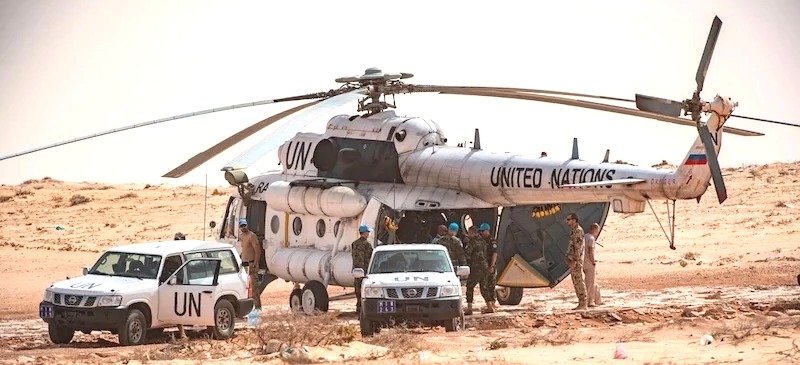
Laayoune; November 2026: The first five (05) military observers from the United Nations mission in the Sahara, MINURSO, departed Laayoune yesterday (Monday – 16th November 2026), marking the start of the mission’s physical withdrawal following the expiry of its mandate on the 31st of October 2026. The five personnel left through Hassan I Airport as part of a phased departure operation expected to continue over the coming days.
The departure of the first five observers represents the initial visible step in the withdrawal process, with further repatriations and facility closures expected as the UN works toward completing the mission’s liquidation. The withdrawal follows the UN Security Council’s failure to renew MINURSO’s mandate during its October 30 meeting, ending more than 35 years of the mission’s presence in the territory.
Since 01st November this month, the mission has entered a liquidation phase involving the repatriation of personnel, closure of operational facilities and removal of equipment. According to United Nation’s arrangements, approximately 160 military observers are expected to be repatriated, alongside a gradual reduction in civilian staff and other personnel associated with the mission.
The process also includes closing and handing over facilities previously occupied by MINURSO, managing vehicles and other assets, dismantling communications and logistical infrastructure, and settling outstanding contracts and administrative obligations. Mission archives and official records will also be processed as part of the closure.
The liquidation is being supervised by a reduced UN team from the Department of Operational Support, headed by Alexander Ivanko, MINURSO’s former chief and the UN Secretary General’s former special representative in the territory. The operation follows a November 4 working session chaired by King Mohammed VI at the Royal Palace in Rabat to examine arrangements for the post-MINURSO period.
A US drafted resolution proposing changes to MINURSO’s mandate failed after Russia exercised its veto, while a competing Russian proposal seeking a conventional mandate extension also failed to secure sufficient votes. Despite the withdrawal, the United Nations has maintained that the end of MINURSO’s field operations does not mean the termination of its political involvement in the Sahara dispute.
UN Secretary-General António Guterres has reaffirmed the organisation’s readiness to support efforts toward a political settlement, including through his personal envoy for the Sahara, Staffan de Mistura.
Earlier, during the two days (November 10th & November 11th) of General Assembly debate on the Sahara, Morocco’s autonomy plan came up in 33 of the 48 substantive interventions, governments on several continents have endorsed it, and seven (07) foreign delegations spoke of the “Moroccan Sahara”.
(i)Autonomy came up more often than self-determination: “Autonomy” appeared 68 times across 33 interventions and “self-determination” 66 times across 23 speeches, with Russia, Algeria, and other governments opposed to Morocco’s settlement using the first word too, mostly to argue it should not settle the territory’s future in advance, in a vocabulary Security Council Resolution 2797 fixed in October 2025 when it made Morocco’s proposal the basis for negotiations, so that governments that back Rabat and governments that resist it now argue inside the same frame.
(ii)Support for Morocco comes in different degrees: Gambia has recognised Moroccan sovereignty over the Sahara, and France reaffirmed that the territory’s present and future lie within Moroccan sovereignty. Guinea and Djibouti called autonomy under Moroccan sovereignty the only credible political solution, and Guinea-Bissau endorsed it as the sole framework. Britain and Portugal backed Morocco’s initiative as a credible basis for negotiation, and Switzerland called genuine autonomy a potentially feasible outcome. Supporting talks built on Morocco’s proposal does not necessarily mean recognising sovereignty or accepting the final settlement in advance.
(iii)Morocco’s preferred terminology gains international use: The phrase appeared 14 times during the proceedings, 12 of them across seven foreign interventions. Bahrain used it four times, speaking for the Gulf Cooperation Council and for itself, Qatar and Côte d’Ivoire twice each, and Guinea-Bissau, Comoros, Togo and Djibouti once each.
(iv)Regional blocs amplify Morocco’s diplomatic backing: Bahrain spoke for all six GCC members, reaffirming their collective support for Morocco’s autonomy initiative as the solution to the dispute, and then, with Qatar and the United Arab Emirates, delivered national remarks to the same effect. The European Union’s formula was narrower, supporting negotiations based on autonomy while keeping the requirement for a mutually acceptable settlement, and Finland, speaking for five Nordic countries, spent its time on Russia’s veto and on preserving the UN-led political process.
(v)European backing has limits that the Security Council vote conceals: France’s unequivocal position contrasts with the more qualified support expressed by several European governments.
Britain considered Morocco’s initiative the most credible and pragmatic basis for a lasting settlement. Portugal described it as the most serious and constructive option.
The EU collectively supported negotiations on that basis, but Latvia expressly stated that its vote for the American Security Council draft did not constitute recognition of Moroccan sovereignty or endorsement of autonomy.
Denmark, another supporter of the draft, maintained that the eventual political outcome could not be predetermined.
The distinction shows why the 11 favourable votes on October 30 cannot be interpreted as 11 separate recognitions of sovereignty, even though the vote represented substantial support for the US-led approach.
(vi)Several governments argue autonomy can satisfy self-determination: Sierra Leone made the most direct legal case, with its representative arguing that autonomy negotiated in good faith and freely accepted by the population could fulfill the principle of self-determination. Japan repeated the position in its May 2026 joint declaration with Morocco, that genuine autonomy under Moroccan sovereignty could be a feasible solution, and Switzerland likewise called autonomy potentially feasible while insisting on a negotiated settlement. Each tied the plan to consent or negotiation, a different position from the governments that endorsed Moroccan sovereignty as the definitive framework.
(vii)MINURSO’s closure produced agreement across opposing camps: Governments divided over sovereignty nevertheless converged on several practical concerns following the mission’s closure.
The transcript audit identified references to the ceasefire in 22 interventions, withdrawal in 17, liquidation in 09 and drawdown in 08. These categories overlap and do not constitute separate blocs of support.
Morocco’s allies welcomed Rabat’s commitment to facilitate an orderly withdrawal. States including Angola and South Africa also called for restraint and continued UN involvement, despite opposing Morocco’s preferred political outcome. Liberia argued that the end of the mission should not mean the end of international engagement.
Team Maverick.