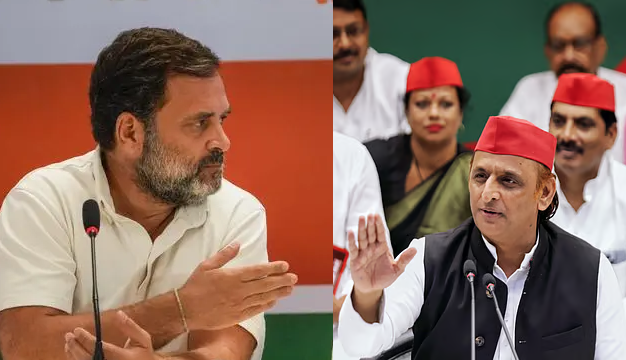
Public exchange between Iqra Hasan and Imran Masood highlights questions over leadership, seat-sharing and strategy within the Opposition alliance
New Delhi, Sep 2026 : A fresh exchange between Samajwadi Party (SP) MP Iqra Hasan and Congress MP Imran Masood has brought differences over political leadership and the Opposition's strategy into focus ahead of the 2027 Uttar Pradesh Assembly elections.
Hasan backed SP president Akhilesh Yadav as the key Opposition leader capable of taking on the Bharatiya Janata Party (BJP) in Uttar Pradesh, while Masood highlighted Congress leader and Lok Sabha Leader of Opposition Rahul Gandhi's national role. Their contrasting positions have drawn attention to the continuing challenge of coordinating the SP-Congress alliance in the country's most populous state.
The remarks came despite repeated assertions by senior leaders of both parties that their alliance remains intact. The latest exchange, however, has again put questions of leadership, political space and the eventual structure of the alliance in the public domain.
The SP has a strong claim to being the principal Opposition force in Uttar Pradesh based on its performance in the 2024 Lok Sabha election. The SP won 37 of the state's 80 Lok Sabha seats, while the Congress won six as an alliance partner, giving the two parties a combined tally of 43 seats.
Akhilesh Yadav has subsequently continued to focus on expanding the SP's social coalition through its PDA framework, referring to the mobilisation of backward classes, Dalits and minorities. Recent political activity by the party has included organisational mobilisation and outreach among different social groups as it prepares for the 2027 Assembly contest.
For the Congress, Rahul Gandhi remains the party's principal national campaigner and the Leader of the Opposition in the Lok Sabha. Congress leaders have continued to emphasise the importance of a broader national Opposition platform, while the SP's political strategy in Uttar Pradesh remains centred on its state-level organisation and Akhilesh Yadav's leadership.
The divergence between the two approaches becomes significant because any electoral arrangement would require decisions on seat-sharing, campaign coordination, messaging and leadership projection. Public statements by individual leaders can add another layer of complexity to negotiations that are likely to become more important as the 2027 election approaches.
Seat-sharing is particularly sensitive in Uttar Pradesh. The SP's stronger performance in the 2024 Lok Sabha election gives it greater bargaining strength within the state, while the Congress has an interest in expanding its organisational and electoral footprint. How the two parties reconcile these interests could shape the eventual contours of their alliance.
The experience of Bihar in 2025 provides a recent example of how alliance negotiations can become a prolonged public issue. Ahead of the Bihar Assembly election, the Rashtriya Janata Dal (RJD) and Congress faced disagreements over seat allocation and the projection of a leadership face. Reports at the time said negotiations became difficult as the two parties differed over the number of constituencies each should contest.
The Bihar Mahagathbandhan eventually went into the election after prolonged negotiations, but the disputes over seat-sharing had remained a prominent feature of the pre-election discourse. The alliance subsequently performed poorly in the 2025 Assembly election, winning 35 of the 243 seats, according to post-election reporting.
The Bihar experience is therefore being cited in discussions about Opposition coordination elsewhere, although Uttar Pradesh has its own political dynamics and the two states cannot be treated as identical electoral situations.
For the SP and Congress, the immediate challenge is to maintain coordination while accommodating the distinct political identities and organisational priorities of the two parties. The 2024 Lok Sabha results demonstrated that the alliance can operate as a joint electoral arrangement, but the upcoming Assembly election will involve a different contest across 403 constituencies and will require decisions on local candidates, constituency-level strategy and campaign messaging.
The BJP, meanwhile, has already begun organisational preparations for the 2027 contest. Its national president Nitin Nabin's recent organisational activity in Uttar Pradesh has included meetings and outreach aimed at strengthening the party's electoral preparations.
For the Opposition, the coming months are likely to involve negotiations over the practical framework of cooperation rather than only the question of who should occupy the most prominent political role.
The latest statements by Hasan and Masood do not by themselves establish a formal change in the SP-Congress alliance. They do, however, illustrate the different political emphases within the two parties: the SP's focus on Uttar Pradesh and Akhilesh Yadav's state-level leadership, and the Congress's emphasis on Rahul Gandhi's wider national role.
With the 2027 Assembly election still ahead, the parties have time to settle questions relating to seat-sharing, campaign coordination and leadership projection. Whether those issues are resolved through internal negotiations or become recurring points of public debate will be an important part of the alliance's organisational preparations.
(Disclaimer :The content of this article is sourced from a news agency and has not been edited by the Mavericknews30 team.)