PM Modi says India-EFTA partnership targets $100 billion investment and one million direct jobs, while new agreements expand cooperation in migration, young professionals, transport, research and startups
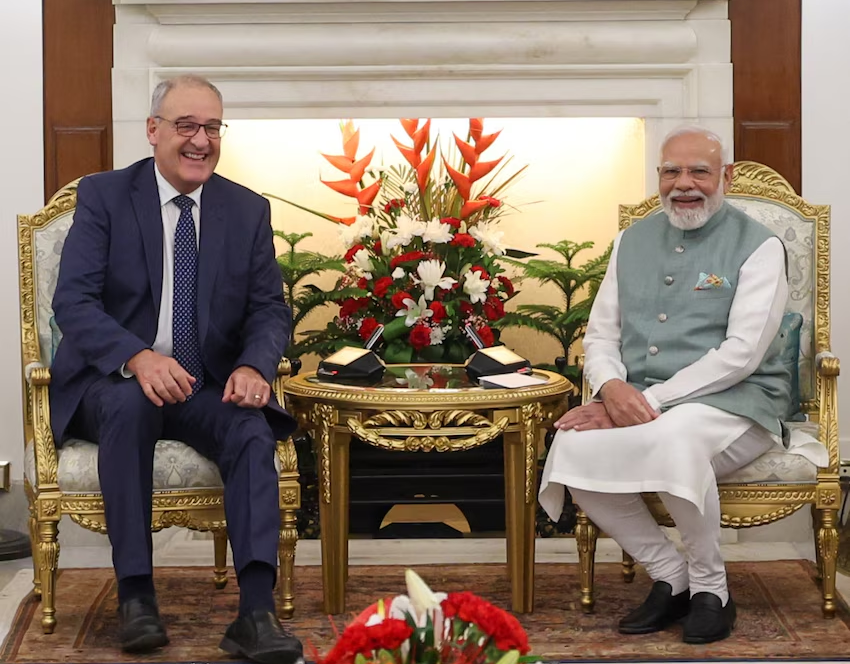
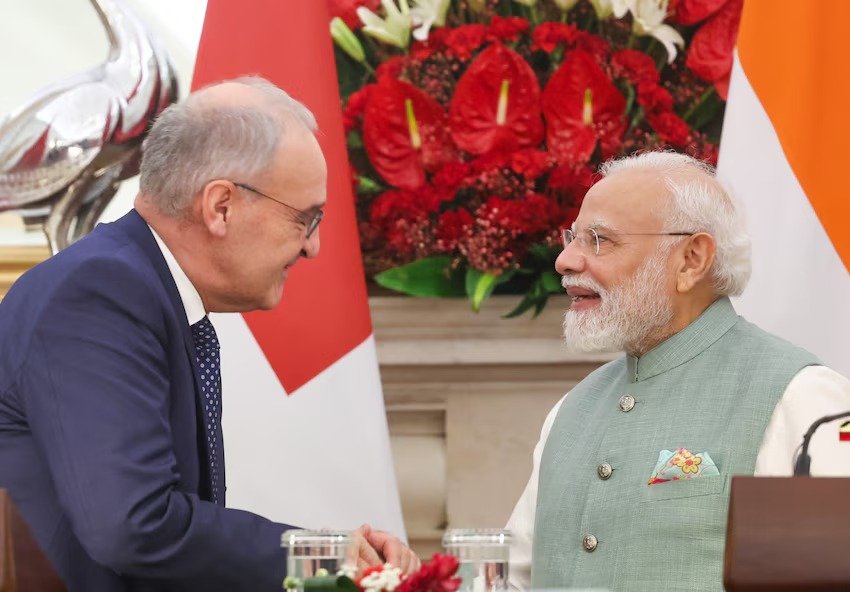
New Delhi, Oct 2026 : India and Switzerland on Monday agreed to deepen cooperation across trade, investment, infrastructure, science and technology, mobility, research, defence and clean energy as Prime Minister Narendra Modi held talks with Swiss Confederation President Guy Parmelin during his state visit to India.
Welcoming Parmelin, Modi said the relationship between India and Switzerland was being given a new impetus through a series of agreements and initiatives covering both economic and people-to-people ties. He recalled that the India-European Free Trade Association (EFTA) Trade and Economic Partnership Agreement (TEPA) was implemented last year with Switzerland’s support.
Modi described the agreement as an ambitious framework for investment, innovation, employment and shared prosperity. India and EFTA have set a target of $100 billion in investment in India and one million direct jobs over the next 15 years.
The Prime Minister said India and Switzerland share longstanding historical ties, with figures such as Swami Vivekananda and Mahatma Gandhi having travelled to Switzerland. He said innovation, infrastructure and advanced technology had emerged as important pillars of the contemporary bilateral relationship.
Trade and investment
India and Switzerland have identified measures to improve market access for Indian exports and facilitate greater investment between the two countries. Modi said the initiatives would support exports of Indian agricultural products, pharmaceuticals, textiles and engineering goods to Switzerland.
At the same time, India is seeking greater Swiss investment in sectors including biotechnology, life sciences, banking, insurance, food processing and sustainability. The two sides also discussed building trusted supply chains and developing reliable solutions for global markets.
The agreements signed during the visit are expected to expand cooperation in transportation technologies, mobility systems, infrastructure, scientific research and entrepreneurship.
Infrastructure and technology cooperation
Transport and infrastructure emerged as another important area of cooperation. Modi cited projects such as the Varanasi ropeway, Jewar Airport in Noida and railway and tunnelling projects in mountainous regions as examples of India-Switzerland infrastructure collaboration.
A new memorandum of understanding between India’s Ministry of Road Transport and Highways and Switzerland’s Federal Department of Economic Affairs, Education and Research seeks to promote sustainable infrastructure and mobility technologies. Areas identified include electric vehicles, ropeways, tunnels, circular economy initiatives and other transport-related sectors.
Modi also invited Swiss infrastructure companies to expand their investments in India and participate in capacity building, design and manufacturing.
The two countries also identified opportunities for greater cooperation in military exchanges and defence production, while agreeing to deepen collaboration in nuclear energy.
Science, research and startups
Science and technology remained a key component of the discussions. India and Switzerland agreed to promote new joint research projects in areas including health, clean energy and space.
A Letter of Intent between India’s Department of Science and Technology and the Swiss National Science Foundation is intended to strengthen long-term cooperation between researchers from both countries, support exploratory scientific collaboration and develop partnerships for future joint research.
An implementation arrangement between the Department of Science and Technology and the Zurich University of Applied Sciences will promote innovation, technology transfer and entrepreneurship. It includes the Indo-Swiss Academia-Industry Training programme for early-stage startups through exchanges, joint workshops, capability building and networking.
The two sides are also set to launch an Indo-Swiss Research Flagship initiative, further strengthening institutional research links.
Mobility and opportunities for young people
People-to-people relations received particular attention during the talks. India and Switzerland signed a Migration and Mobility Partnership Agreement aimed at facilitating orderly migration and mobility while addressing irregular migration, human exploitation and trafficking in accordance with national laws.
The agreement provides for multiple-entry visas of up to five years, including stays of up to six months per visit, as well as renewable one-year student permits.
The two countries also signed an Agreement on the Exchange of Young Professionals. Under the arrangement, up to 300 young professionals from each country can participate annually, with the possibility of increasing the number to 500. The programme is designed to provide temporary employment opportunities and help participants develop professional and language skills.
Yoga, Ayurveda and global cooperation
India and Switzerland also discussed cooperation in Yoga and Ayurveda, which have gained popularity in Switzerland. Modi said the two sides had discussed ways to further deepen collaboration in these areas.
On global issues, Modi said India and Switzerland share commitments to democratic values, the rule of law, dialogue and diplomacy. He said both countries would continue working towards global peace and stability and support meaningful efforts aimed at resolving conflicts.
India also reiterated the need for reforms in global institutions to enable them to respond more effectively to emerging international challenges.
India-EFTA Prosperity Summit and AI
President Parmelin arrived in India with a business delegation, and Modi said the upcoming India-EFTA Prosperity Summit on October 7 would provide an opportunity for business leaders to translate the commitments under the trade and investment partnership into concrete outcomes.
The Prime Minister also highlighted cooperation in artificial intelligence. India hosted a major AI summit in February, while Switzerland is scheduled to host the Geneva AI Summit next year. Modi said both countries could contribute to developing AI that is responsible, inclusive and human-centric.
The latest agreements and initiatives expand the India-Switzerland relationship beyond traditional trade and investment, bringing together mobility, infrastructure, research, innovation, startups and technology.
List of Key Outcomes
| S.No. | Agreement/Initiative | Key Outcome |
|---|---|---|
| 1 | Migration and Mobility Partnership | Facilitates orderly migration and mobility; provides multiple-entry visas of up to five years and renewable one-year student permits. |
| 2 | Young Professionals Agreement | Enables temporary employment exchanges; initially covers 300 participants annually from each country, expandable to 500. |
| 3 | Transport, Mobility and Infrastructure MoU | Promotes cooperation in EVs, ropeways, tunnels, circular economy and sustainable infrastructure. |
| 4 | DST-SNSF Letter of Intent | Strengthens long-term scientific collaboration and joint research partnerships. |
| 5 | DST-Zurich University Implementation Arrangement | Supports innovation, technology transfer and entrepreneurship through the Indo-Swiss Academia-Industry Training programme. |
| 6 | Indo-Swiss Research Flagship | Launches a new platform for flagship research collaboration between India and Switzerland. |
| 7 | India-EFTA Prosperity Summit | Brings together business leaders to advance trade, investment and economic partnership. |
| 8 | AI Cooperation | Builds on India’s AI initiatives and Switzerland’s forthcoming Geneva AI Summit, with focus on responsible and human-centric AI. |
The outcomes announced during Parmelin’s visit reflect an expansion of bilateral cooperation into areas directly linked to investment, talent mobility, infrastructure, research and emerging technologies.