Target to Complete Crop Damage Assessments Within a Week and Provide Aid Before Diwali
Mumbai, October 2026 : Against the backdrop of drought conditions being declared across all talukas of Jalna district, Maharashtra Animal Husbandry and Environment Minister and Guardian Minister Pankaja Munde has directed the district administration to undertake detailed planning for water supply, fodder, crop losses, crop insurance and employment guarantee scheme works.
Munde directed officials to ensure that every available drop of water is conserved. She called for GPS-based monitoring of every tanker trip, arrangements for groundwater recharge at tanker distribution points and greater focus on deepening and rejuvenating rivers and streams and strengthening existing water sources.
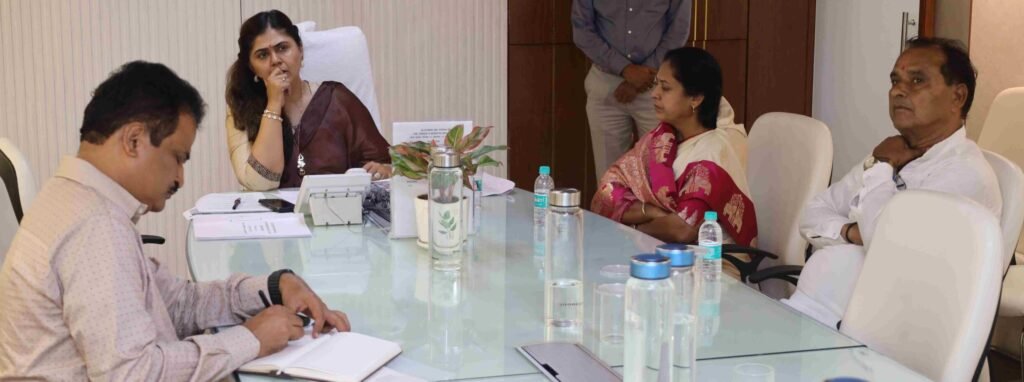
A review meeting on the drought situation in Jalna district was held through videoconferencing under Munde’s chairpersonship. The meeting reviewed crop damage assessments, crop insurance, water storage in dams, drinking water availability, fodder, water tankers, employment guarantee scheme works and water supply in urban areas. Jalna District Collector Ashima Mittal, Jalna Municipal Commissioner Anjali Sharma and other officials were present.
Munde said drinking water must receive the highest priority during the drought and every available drop should be used judiciously. She directed the District Collector to prepare and submit a comprehensive Standard Operating Procedure covering drinking water, dam storage, strengthening of water sources, tanker management and measures to prevent water wastage.
According to the administration, 954 villages in Jalna district are facing drought conditions, with nearly 6.78 lakh hectares of agricultural land covered under crop damage assessments. Assessments have so far been completed in around 60 per cent of villages, covering approximately 53 per cent of the affected area and 61 per cent of farmers.
Jalna has around 5.81 lakh landholders, of whom assessments have been completed for approximately 3.56 lakh. Munde directed the administration to complete the remaining assessments within a week and submit the reports to the government, with the objective of ensuring that financial assistance reaches farmers before Diwali.
Transparency in Crop Damage Assessments
Crop damage assessments have been ordered to be conducted jointly by teams comprising talathis, gram sevaks and agricultural assistants. In view of last year’s experience, the government is placing special emphasis on transparency and objectivity in the assessment process.
Officials were also directed to exercise particular caution regarding crop insurance. More than two lakh farmers in the district have reportedly taken crop insurance. Of the 312 proposed experiments for soybean assessment, 95 have been completed, officials said.
Limited Water Storage in Dams
Munde directed officials to carefully manage the limited water available in major, medium and minor irrigation projects across the district.
She said tanker filling and distribution points should be identified through GPS to prevent wastage. Groundwater recharge facilities should be created at places where tankers distribute water so that no water is wasted.
She also directed authorities to strictly restrict the digging of borewells without permission. Every tanker should be equipped with GPS and monitored from the point of filling to the final distribution point. Water-recharge trenches or soak pits should be created at tanker parking and distribution locations, allowing spilled water to be used for groundwater recharge. Arrangements should also be made to recharge nearby wells and hand pumps.
The minister directed officials to effectively implement the order for a 10 per cent reduction in water consumption. Necessary controls should ensure that potable or treated drinking water is not used for construction, crusher, road and highway projects. Industries should use treated or recycled water wherever possible.
Munde said efforts would also be made at the government level to formulate a policy regulating the use of drinking water for private construction activities.
Proper Fodder Planning
Munde directed officials to use the fodder literacy campaigns being conducted in every taluka to demonstrate methods such as silage production, hydroponics and azolla cultivation, besides promoting efficient use of available fodder.
She called for the use of silt-deposited areas for fodder production. Wherever necessary, fodder depots should be established at the village level, with fodder and water planned according to the number of tagged livestock.
Water Conservation Through Employment Guarantee Scheme
Munde called for linking employment guarantee scheme works with water conservation so that people receive employment during the drought while creating assets to address future water shortages.
She directed officials to prioritise the deepening and rejuvenation of rivers and streams, strengthening of water sources and desilting works.
“Plan from now itself, keeping in mind the possibility of drought next monsoon as well. Every drop of water that comes must be stopped and allowed to percolate into the ground,” she said.
Audit of Wells and Ponds
The minister directed officials to survey neglected and silted wells and undertake their cleaning and restoration. Natural as well as artificial ponds should also be audited and necessary works planned to increase water storage in the coming period.
The meeting also reviewed municipal water supply. Efforts will be made to coordinate with the concerned agencies to restart the Khadakpurna water supply scheme, which has remained shut due to pending electricity bills.
Munde directed that funds be released in phases for recharge shafts, check dams and stream-deepening works in villages facing the possibility of severe water shortages.
Special Focus on Farmer Counselling
Considering the mental stress faced by farmers due to drought, Munde directed authorities to conduct farmer counselling programmes in villages.
Gram sevaks, talathis, ASHA workers, anganwadi workers and sarpanchs should pay special attention to vulnerable families, she said.
“During a drought, arranging water and fodder alone is not enough. Giving farmers confidence and maintaining communication with them is equally important,” Munde said.
250 Villages Proposed for Adoption
District Collector Ashima Mittal proposed a village adoption initiative for areas facing severe water shortages, involving organisations, individuals, temples, hospitals and educational institutions.
Plans are being prepared to cover around 250 villages under the initiative. The objective is to maintain communication with drought-affected families, provide necessary assistance and offer social support during the Diwali period.
Munde welcomed the initiative and said she would personally adopt a village as part of the programme.
Mittal said crop damage assessments were progressing rapidly across Jalna district and would be completed soon. District Women and Child Development Project Officers have also been directed to hold meetings with women in every village and provide counselling.
The administration is also considering organising mass marriage ceremonies to reduce difficulties faced by families arranging marriages for their daughters during the drought. Initiatives such as farmer dialogue programmes will also be undertaken, officials said.