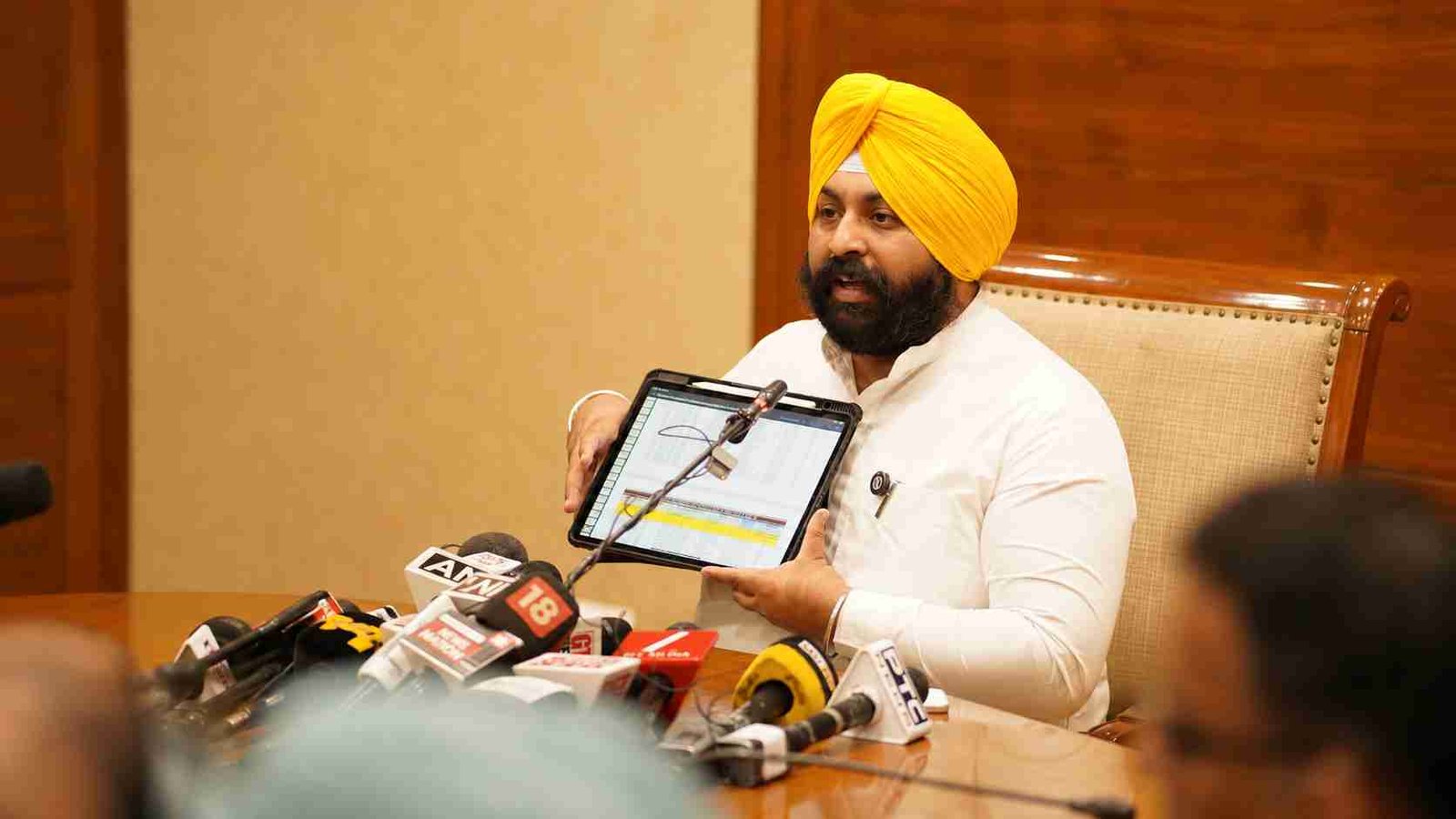
Chandigarh, Aug 2026: Presenting the four-and-a-half-year report card of Punjab’s school education sector, Education Minister Harjot Singh Bains said the Bhagwant Mann-led government has transformed the state’s education infrastructure through an investment of Rs 2,300 crore. He claimed that Punjab has emerged as the leading state in school education, surpassing Kerala in the NITI Aayog’s 2026-27 report.
Addressing a press conference at Punjab Bhawan, Bains said that since 2022, as many as 3.64 lakh students have shifted from private schools to government schools, reflecting growing public confidence in the state-run education system. He attributed the change to the sustained efforts made by the Aam Aadmi Party government after it assumed office in March 2022 to strengthen and improve government schools across Punjab.
Recalling the AAP’s electoral promise, Bains said, “AAP national convenor Arvind Kejriwal and Chief Minister Bhagwant Singh Mann had gone to villages and cities across Punjab seeking an opportunity to transform government schools. The people responded positively and gave AAP 92 seats, demonstrating their progressive outlook. We have continuously worked to live up to this trust.”
Bains said that when the present government assumed office in 2022, it inherited a deteriorated education system from previous governments. According to him, many schools did not even have boundary walls, more than 5,000 schools lacked usable toilets, around four lakh children were forced to sit on floors, nearly 500 schools did not have drinking water facilities and students received textbooks up to five months late.
Highlighting the transformation in infrastructure, Bains said the Bhagwant Mann government had invested Rs 2,300 crore in school infrastructure over the past four-and-a-half years, amounting to an average investment of around Rs 15 lakh per school. As part of the improvements, 13,920 new toilets have been constructed, ensuring that every school now has usable toilet facilities. Around two lakh benches have also been provided so that no child has to sit on the floor.
He said more than 9,000 new classrooms and laboratories have been constructed, while over 10,000 interactive panels have been installed in classrooms. In addition, 5,012 schools have been upgraded with modern computer laboratories. All government schools in Punjab are now equipped with Wi-Fi, while 99.9 per cent of schools have boundary walls.
Bains also highlighted the pace of infrastructure development, saying that the construction of 9,000 classrooms in four-and-a-half years represented a significant achievement for the government.
He said government schools now offer sports facilities that were earlier largely available only in private institutions, including swimming pools, shooting ranges, basketball and tennis courts, kabaddi mats, wrestling facilities and boxing rings.
The Education Minister also highlighted initiatives aimed at improving teachers’ professional skills. Principals were sent to Singapore for training, primary teachers to Finland and head teachers to IIM Ahmedabad in different batches.
On school security and maintenance, Bains said former servicemen had been appointed as campus managers in all senior secondary schools. Two security guards have also been deployed in every senior secondary school with more than 500 students. Schools are being provided monthly cleanliness funds ranging from Rs 3,000 to Rs 50,000 depending on their student strength.
Highlighting improvements in academic performance, Bains said 786 government-school students qualified for JEE and 2,166 cleared NEET over the past four years. The number of government-school students qualifying for NEET-UG increased from just 80 in 2021 to 882 in 2026, representing more than a tenfold rise. The number stood at 437 in 2024, 847 in 2025 and 882 this year. A total of 361 students cleared JEE Main, while 64 qualified for JEE Advanced.
Bains reiterated that the migration of 3.64 lakh students from private to government schools since 2022 was the most significant indicator of growing public confidence in the state’s government education system.
He further claimed that Punjab had topped the country in classroom learning outcomes in the NITI Aayog’s 2026-27 report, surpassing Kerala, which has traditionally been regarded as a benchmark in school education.
On innovation, Bains said Punjab had become the first state to introduce Artificial Intelligence as a core subject from Classes 1 to 12. He also highlighted the Business Blasters programme, through which 2.30 lakh students received practical exposure to entrepreneurship. The government provided Rs 29 crore as seed money, while students generated profits of Rs 3 crore through their ventures.
The government has also opened 40 specialised skill education schools aimed at bringing back students who drop out after Class 10 and helping them continue their education through skill-based learning.
To reduce the financial burden on parents, Bains said the government had restricted annual fee hikes in schools to a maximum of five per cent, providing relief to families amid rising education costs.
He also said Punjab had introduced free bus services for students of government schools, benefiting more than 15,000 students from hundreds of schools every day.
Despite two severe floods in 2023 and 2025 that damaged more than 7,000 schools across Amritsar, Gurdaspur, Ropar, Ferozepur and Fazilka, the government remained committed to transforming the education system, Bains said. With World Bank support, repairs are being carried out at 500 severely damaged schools, with most of the work expected to be completed within six months.
Emphasising his personal commitment to improving school education, Bains said he had personally visited more than 2,000 schools across every district of Punjab.
“There are around 20,000 schools in Punjab and I am on a mission,” he said, adding that within two years, Punjab would become the first state to proudly say that its schools lack nothing. “Education is our biggest priority,” he said.