Pune Growth Hub proposes 58 priority projects, Rs 9-10 lakh crore investment and 15-20 lakh additional jobs
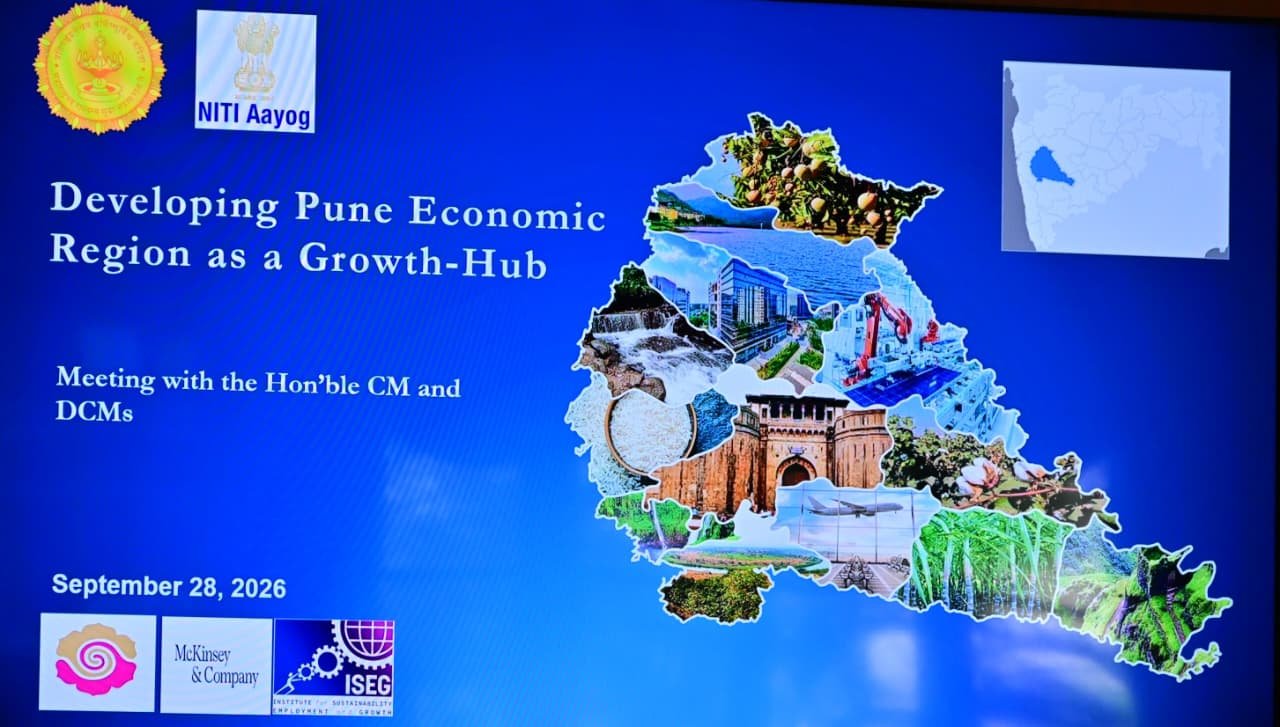
Mumbai, Sept 2026 : A comprehensive development plan for the Pune Economic Region under the NITI Aayog’s ‘Growth Hub’ initiative was presented before Chief Minister Devendra Fadnavis, with a target of expanding the region’s economy to $200-220 billion by 2036.
The plan proposes 58 priority projects, an estimated investment of Rs 9-10 lakh crore and the creation of around 15-20 lakh additional jobs. Strengthening public transport, providing affordable housing and protecting the environment are among the key objectives of the plan.
The Pune Growth Hub plan was presented at a meeting held at Sahyadri Guest House. Minister of State Madhuri Misal, Chief Secretary Rajesh Aggarwal, Maharashtra Finance Commission Chairman Nitin Kareer and secretaries of various departments were present. ISEG Managing Director Shirish Sankhe and McKinsey’s Raunak Shah made the presentation.
The Pune Economic Region Growth Hub process began on August 1, 2025, under the NITI Aayog initiative. The plan has been prepared with the participation of NITI Aayog, the Maharashtra government and Pune International Centre and covers areas under the Pune Municipal Corporation, Pimpri-Chinchwad Municipal Corporation and Pune Metropolitan Region Development Authority (PMRDA).
The plan was prepared following extensive consultations with citizens, industries, educational institutions and local organisations.
Target to Raise Pune’s Economic Growth Rate to 10 Per Cent
Pune currently contributes around 11-12 per cent to the state’s income. However, its current real economic growth rate is estimated at 6-6.5 per cent, and the plan aims to raise it to 10 per cent.
As part of the state’s goal of building a $5 trillion economy by 2047, the Growth Hub plan proposes increasing the Pune Economic Region’s economy from $68 billion in 2025-26 to $200-220 billion by 2035-36.
The plan envisages 58 projects, Rs 9-10 lakh crore in investment, additional employment opportunities and comprehensive development across seven key growth areas.
Around 15 million people currently live in the Pune Economic Region. The plan aims to ensure that the benefits of development reach all residents, expand employment opportunities, improve quality of life and protect the environment.
It also seeks to position the Pune Economic Region among Asia’s most liveable regions.
Global Hub for High-Tech Manufacturing
The plan prioritises six sectors — manufacturing, automobiles and electric vehicles, engineering goods, defence, robotics and drones, electronics and semiconductors, and biotechnology.
Proposed projects include an electric vehicle and future mobility hub, a high-tech engineering park, electronics and defence technology facilities, a robotics manufacturing centre, information technology and global capability centres, and artificial intelligence hubs.
These sectors are expected to have the potential to generate four to five lakh additional jobs.
The plan also proposes increasing the number of startups to more than 10,000 and reskilling 1.5-2 lakh technology professionals in artificial intelligence, cloud computing and cybersecurity.
Up to 76 Lakh Jobs Targeted Over Next Decade
The Pune Economic Region currently has around 56 lakh jobs. The plan aims to increase this to around 74-76 lakh over the next 10 years, creating an additional 12-20 lakh employment opportunities across manufacturing, services, healthcare, education, tourism, agro-processing and transport.
The objective is to provide local residents with greater employment and livelihood opportunities.
Six Key Areas Identified for Tourism Development
The plan aims to place the Pune Economic Region among the country’s top 10 tourism destinations by focusing on six areas — forts and lakes circuits, sports and adventure tourism, health and wedding tourism, event tourism, wildlife tourism, and religious and cultural tourism.
Key proposals include a Chhatrapati Shivaji Maharaj Fort Circuit connecting Shivneri, Lohagad, Rajgad and Sinhagad; water tourism centres at Pawna and Bhatghar; a 600-km Sahyadri open trekking route; a health tourism belt; an event and entertainment centre at PIECC; and a Junnar leopard safari.
Expansion of Public Transport and Infrastructure
To increase the share of public transport from 13 per cent to 50 per cent, the plan proposes 11 railway projects, 13 road projects, a 250-km metro network, 12,000-14,000 buses and six multimodal transport hubs.
The target is for at least 50 per cent of daily trips in the Pune Economic Region to be made through public transport, providing residents with more travel options and reducing dependence on private vehicles.
90 Per Cent Rehabilitation Target for Eligible Slum Dwellers
The plan places emphasis on redevelopment of slum areas and rehabilitation of eligible families. It sets a target of rehabilitating around 90 per cent of eligible families by 2036.
The plan also proposes construction of four to five lakh affordable homes for different income groups, industrial workers, students and technology-sector employees, including one lakh worker hostels.
Cluster-based redevelopment of densely populated areas has also been proposed.
Agriculture and Food Processing as Rural Growth Drivers
Horticultural crops such as grapes, bananas, pomegranates, figs and strawberries, along with dairy, food processing, cold storage and biofuel projects, are proposed as key drivers of the rural economy.
The plan identifies areas for setting up processing industries, cold chains and related infrastructure. It aims to increase the gross value added of the agriculture and food-processing sector from $5 billion to $10-12 billion.
Water Supply Planning
The Pune region is estimated to require an additional 200 million litres of water per day.
The plan proposes several measures, including seven TMC of water from Mulshi, increased water supply from the Bhama basin, water reuse, efficient distribution and desilting of water reservoirs.
Skill Development Opportunities for Women and Youth
The plan proposes expanding skill-development programmes, industrial training institutes and university courses to provide more employment opportunities for women and young people.
Training and educational opportunities will be developed in emerging sectors such as electric vehicles, electronics, robotics and biotechnology. Increasing women’s participation in employment will also be a focus.
Strategic Policy Reforms Proposed
The plan proposes new policies for semiconductors, industrial worker housing and rural-urban transition, along with strategic reforms related to micro, small and medium enterprises, integrated townships, tourism, cluster redevelopment, autonomous industrial townships, private industrial parks, startups, slum redevelopment and non-fare bus operations.
For implementation of the plan, a regulatory council chaired by the Chief Minister, a state steering committee headed by the Chief Secretary, a Pune Growth Hub steering committee and a project management unit under the PMRDA have been proposed.
Additional Chief Secretary of Transport Sanjay Sethi, Additional Chief Secretary of Forests Milind Mhaiskar, Additional Chief Secretary of Finance Vikas Chandra Rastogi, Additional Chief Secretary of Higher and Technical Education B. Venugopal Reddy, Maharashtra Finance Commission Chairman Nitin Kareer, Principal Secretary of Industries P. Anbalagan, Pune Municipal Commissioner Navalkishore Ram, Pune District Collector Jitendra Dudi, Pune Zilla Parishad Chief Executive Officer Gajanan Patil, Maharashtra Security Force Director General Rajvardhan, PMRDA Metropolitan Commissioner Abhijit Chaudhary and Pimpri-Chinchwad Police Commissioner Vinay Kumar Choubey, among others, attended the meeting.