Chief Minister Dr. Mohan Yadav chaired the Cabinet meeting held at the Mantralaya on Thursday. The Cabinet approved the formation of the wholly state-owned Jabalpur-Indore Economic Corridor Development Company Limited to accelerate industrial development and investment in Madhya Pradesh.
In a major decision in the interest of farmers, the Cabinet also approved the implementation of the Bhavantar Bhugtan Yojana under the Pradhan Mantri Annadata Aay Sanrakshan Abhiyan (PM-AASHA) for Kharif 2026 to help soybean farmers receive prices in line with the Minimum Support Price (MSP). The Cabinet also approved proposals worth approximately ₹27,050 crore to accelerate the state's overall development.
The Cabinet approved ₹3,076.37 crore for the continuation of irrigation projects in Burhanpur, Raisen, Mandsaur and Singrauli for the financial years 2026–27 to 2030–31. It also approved ₹15,557.35 crore for the continuation of various schemes under the Law and Legislative Affairs Department during the 16th Finance Commission period, from April 1, 2026, to March 31, 2031.
An allocation of ₹5,232 crore was approved for AYUSH healthcare services and the continuation of the National AYUSH Mission. The Cabinet also approved ₹2,875.20 crore for the continuation of schemes related to the construction and expansion of government school infrastructure. In addition, 24 new posts were approved for district-level Women and Child Development offices in the newly formed districts of Niwari, Mauganj, Pandhurna and Maihar. A provision of ₹241.88 crore was also approved for student transportation in 94 Sandeepani schools operated by the Tribal Affairs Department.
Formation of Special Company Approved for Jabalpur-Indore Industrial Corridor
The Cabinet approved the formation of the wholly state-owned Special Purpose Vehicle (SPV), Jabalpur-Indore Economic Corridor Development Company Limited, for the integrated development of selected industrial and economic hubs along the Jabalpur-Indore Industrial Corridor. The company will be entirely owned and controlled by the Madhya Pradesh government. The state government will provide initial paid-up capital of ₹100 crore to establish a strong financial foundation for the company. A high-level Governing Council, chaired by the Chief Minister, will be constituted to oversee its operations and policy decisions. The company's activities will be managed through a strong Executive Body chaired by a Vice-Chairperson nominated and appointed by the Chief Minister. To facilitate the rapid and systematic development of economic hubs, the company will be empowered to identify, manage, acquire and develop land; undertake zoning, master planning and layout preparation; allot plots; grant leases and subleases; monetise land; and develop basic and social infrastructure. Where required, government land will be made available to the company at concessional rates or under prescribed conditions, subject to approval by the competent authority. If forest land is required for a project, it will be made available only after fulfilling all applicable central and state legal requirements, obtaining prior approvals, and meeting conditions relating to compensatory afforestation and Net Present Value (NPV).
The company will be authorised as an appropriate Investment Region Agency under the Madhya Pradesh Investment Area Development and Management Act, 2013. It will also be assigned the necessary powers and responsibilities as the nodal agency for notified economic hubs under the Madhya Pradesh Ease of Doing Business Act, subject to the concurrence of the Law Department. The company will not be responsible for constructing the main roads or the corridor itself. Its activities will focus exclusively on developing internal and common infrastructure within economic hubs and promoting economic activity. Through this company, industrial parks and sector-specific parks—including food parks, agro-processing parks, logistics parks, technology and IT parks, and Global Capability Centres (GCCs)—will be developed alongside shared facilities and residential and social infrastructure.
Various implementation models, including Public-Private Partnerships (PPPs), Engineering, Procurement and Construction (EPC), concession agreements, leases, joint ventures and development agreements, may be adopted for these projects. The Department of Industrial Policy and Investment Promotion has been authorised to coordinate with the departments concerned, including Finance, Revenue, Urban Development and Housing, Panchayat and Rural Development, Water Resources, Energy, Public Works, Forests and Law, and issue the necessary notifications, government orders and other statutory documents for timely implementation.
Bhavantar Scheme Approved to Ensure Fair Prices for Soybean Farmers
The Cabinet approved the implementation of the Bhavantar Yojana to ensure fair prices for soybean farmers during Kharif 2026. The scheme will be implemented in accordance with the guidelines of the Price Deficiency Payment Scheme (PDPS) under the Government of India's Pradhan Mantri Annadata Aay Sanrakshan Abhiyan (PM-AASHA). Its primary objective is to ensure that farmers receive the Minimum Support Price for soybean produce of average quality. Soybean farmers must register on the Food Department's e-Uparjan portal by October 17, 2026, to avail themselves of the scheme. The sale period at designated mandis has been fixed from October 22, 2026, to January 15, 2027, subject to revision if necessary.
Payments will be calculated based on the farmer's registered cultivated area and the state-level average productivity determined by the department for the previous year. If a farmer has sold soybean at a mandi before the scheme's designated sale period, between October 1 and October 21, 2026, the quantity already sold will be deducted from the farmer's total eligible quantity. Bhavantar payments will be admissible only on the remaining eligible quantity. A model rate system will be introduced to ensure transparency in the payment process. For the first 14 days of the season, the model rate will be determined using the weighted average across all mandis in the state and will remain effective from October 22 for the subsequent 14-day period. Thereafter, the model rate will be calculated daily on the basis of the preceding 14-day weighted average and displayed on the e-Mandi portal.
The payment mechanism will operate as follows:
If the sale price is equal to or higher than the MSP, no compensation will be payable.
If the sale price is below the MSP but higher than the model rate, the farmer will receive the difference between the MSP and the actual sale price.
If the sale price is equal to or below the model rate, the farmer will receive the difference between the MSP and the declared model rate.
Payments will be transferred directly to farmers' registered bank accounts through Direct Benefit Transfer (DBT). Implementation committees will be constituted at the state level under the Chief Secretary and at the district level under the respective Collectors. The Mandi Board will make the Bhavantar payments directly to farmers' bank accounts through DBT. These payments will initially be reimbursed from the Price Stabilisation Fund operated by the State Agricultural Marketing (Mandi) Board. If the fund has insufficient resources, the state government will provide the Mandi Board with an interest-free credit limit of ₹1,500 crore for one year.
₹241.88 Crore Approved for Student Transport in 94 Sandeepani Schools
The Cabinet approved ₹241.88 crore for student transportation in 94 Sandeepani schools operated by the Tribal Affairs Department. Under the approval, the annual transportation rate will be increased from ₹10,000 to ₹21,000 per student, with an additional 5% annual escalation. Transportation services will be operated through outsourcing, using an IT-based platform and monitoring system.
24 New Posts Approved for Women and Child Development Offices in Four Districts
The Cabinet approved the creation of 24 new posts and the replacement of 12 posts for District Programme Officer offices under the Women and Child Development Department in the newly formed districts of Niwari, Mauganj, Pandhurna and Maihar. Human resources on an outsourced basis were also approved, in accordance with the Government of India's approval, for the Integrated Child Protection Scheme and Saksham Anganwadi and Poshan 2.0 schemes.
₹3,076.37 Crore Approved for Continuation of Irrigation Projects
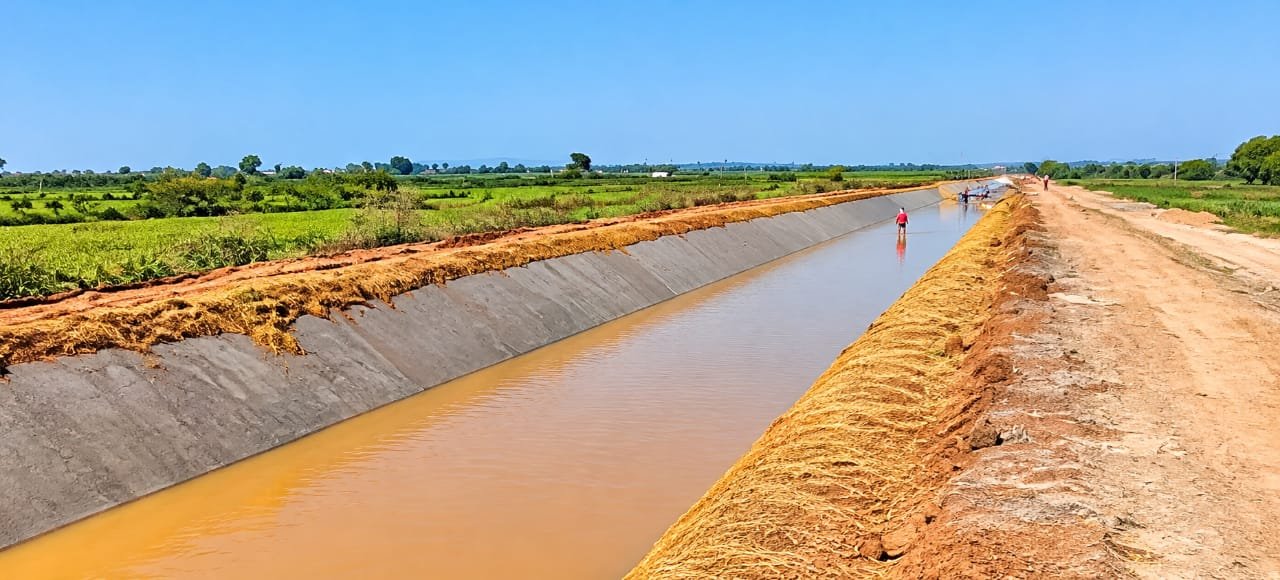
The Cabinet approved ₹3,076.37 crore for the continuation of irrigation projects in Burhanpur, Raisen, Mandsaur and Singrauli for the period from the financial year 2026–27 to 2030–31. Jhirmiti Medium Irrigation Project, Burhanpur: An allocation of ₹922.91 crore was approved for the continued operation of the project. It will provide irrigation to approximately 17,700 hectares of agricultural land across 42 villages in the Khaknar tehsil of Burhanpur district.
Barna Major Irrigation Project, Raisen: An allocation of ₹82.49 crore was approved for continuation of the project. Its primary objective is to expand, strengthen and modernise the existing canal network. The project currently provides irrigation to approximately 91,000 hectares.
Kayampur-Sitamau Pressurised Micro-Irrigation Project, Mandsaur: An allocation of ₹750.83 crore was approved for continued implementation. The project will provide micro-irrigation facilities to 1,12,000 hectares in Mandsaur district.
Chitrangi Pressurised Micro-Irrigation Project, Singrauli: An allocation of ₹1,320.14 crore was approved for continued implementation. The project will provide irrigation facilities through a pressurised micro-irrigation system across 32,125 hectares.
₹15,557.35 Crore Approved for Schemes under Law and Legislative Affairs Department
The Cabinet approved ₹15,557.35 crore for the continuation of various schemes under the Law and Legislative Affairs Department during the 16th Finance Commission period, from April 1, 2026, to March 31, 2031. An allocation of ₹1,624.69 crore was approved for the continuation of 11 schemes, including those relating to administrative tribunals under the Registrar, Madhya Pradesh High Court; computerisation of courts; and special courts. A further ₹150 crore was approved for the maintenance of departmental assets. An allocation of ₹12,252.66 crore was approved for schemes covering the salaries, allowances and office expenses of judicial officers and court employees serving in subordinate courts across the state, including district and sessions courts and civil courts. Another ₹1,530 crore was approved for schemes relating to the construction of court buildings.
₹71.81 Crore Approved for the State Information Commission
The Cabinet approved ₹71.81 crore for the continuation of schemes relating to the establishment of the State Information Commission and the maintenance of departmental assets under the General Administration Department during the 16th Finance Commission period, from the financial year 2026–27 to 2030–31. Of the total allocation, ₹69.61 crore will be used for salaries, allowances and other expenditure relating to officers and employees of the State Information Commission. The remaining ₹2.20 crore has been earmarked for the maintenance of departmental assets.
₹1,697.62 Crore Approved for Continuation of the National AYUSH Mission
The Cabinet approved ₹1,697.62 crore for the continuation of the National AYUSH Mission during the 16th Finance Commission period, from April 1, 2026, to March 31, 2031. Launched by the Ministry of AYUSH, Government of India, the mission aims to mainstream AYUSH systems of healthcare. In Madhya Pradesh, the scheme provides funding for the development and establishment of AYUSH hospitals, dispensaries and colleges. Under the mission, construction work is underway for seven approved Ayurvedic colleges. An additional Ayurvedic college is being constructed in Dindori district using funds from the District Mineral Foundation.
₹3,535 Crore Approved for AYUSH Colleges and Hospitals
The Cabinet approved ₹3,535 crore for the continuation of the AYUSH Department's umbrella scheme covering AYUSH colleges and hospitals during the 16th Finance Commission period, from April 1, 2026, to March 31, 2031.
The allocation includes: ₹3,072.54 crore for schemes relating to AYUSH colleges, ₹280.05 crore for government homoeopathic colleges, ₹182.20 crore for Unani colleges, ₹31 lakh for the Late Pandit Uddhavdas Mehta Vaidya Shastri Ayurved Award, The umbrella scheme covers establishment expenditure and building construction for seven Ayurvedic colleges, one homoeopathic college and one Unani college.
₹2,875.20 Crore Approved for Government School and Sports Infrastructure
The Cabinet approved ₹2,875.20 crore for the continuation of schemes relating to the construction and expansion of government schools, hostels, libraries and residential sports facilities during the financial years 2026–27 to 2030–31. A total of 7,122 government high schools and higher secondary schools are currently operating under the School Education Department in Madhya Pradesh.
The scheme will provide improved facilities in government high and higher secondary schools, including classrooms, laboratories, libraries, computer rooms, principals' rooms, staff rooms and campus infrastructure. It will also provide classroom furniture for students, green boards, interactive panels and security cameras, thereby improving the learning environment and facilities available to students.