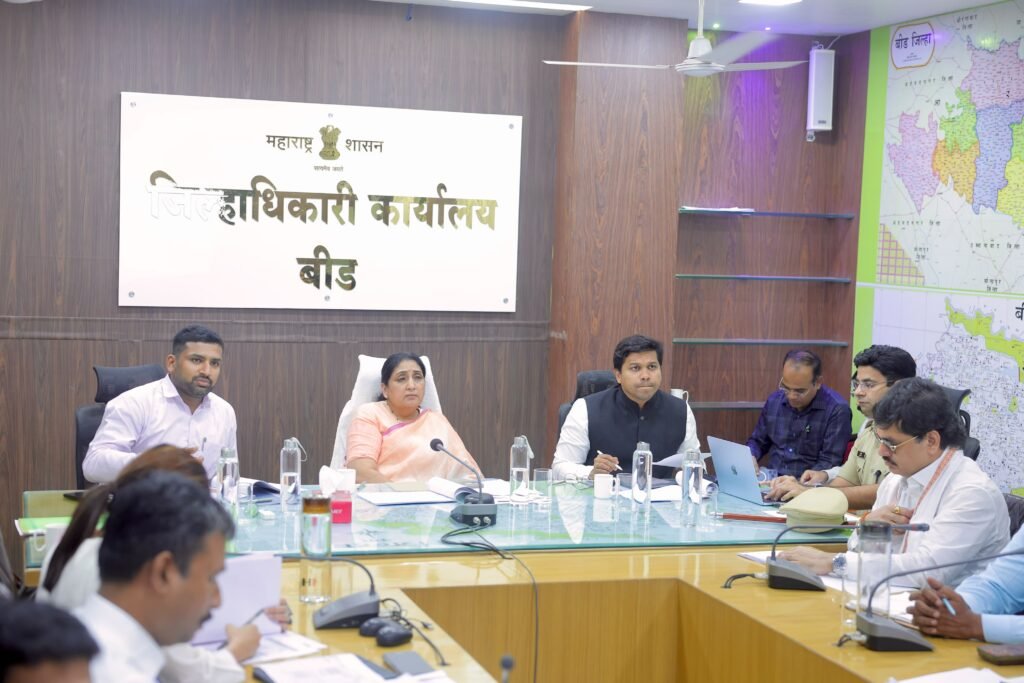
Beed, October 2026 : Maharashtra Deputy Chief Minister and Beed district guardian minister Sunetra Ajit Pawar on Saturday reviewed the severe drought situation in the district caused by a prolonged dry spell, along with the administrative measures being undertaken to address the crisis.
The detailed review meeting was held at the Beed District Collector’s Office and attended by MLAs Prakash Solanke and Dhananjay Munde, District Collector Vivek Johnson, Zilla Parishad Chief Executive Officer Jitin Rahman, Superintendent of Police Navneet Kawat, Resident Deputy Collector Shivkumar Swami, District Superintendent Agriculture Officer Subhash Salve, District Planning Officer Sheela Misal and senior officials from the departments concerned.
Immediate Measures to Address Drought
With the prolonged absence of rainfall damaging standing crops, the district is facing an acute shortage of drinking water and fodder for livestock. Against this backdrop, Pawar directed the administration to complete crop damage assessments, or panchnamas, on a priority basis.
Most of the assessments are nearing completion. Officials were instructed to expedite further action in accordance with the rules as soon as the reports are received. Agriculture and revenue officials were also directed to ensure complete transparency and accuracy in the crop insurance process.
Pawar appealed to citizens to avoid unnecessary expenditure during the drought and water scarcity period. She urged families to cut down on spending on weddings and birthday celebrations and consider organising mass marriage ceremonies.
Drinking Water Given Top Priority
Ensuring drinking water supplies has been accorded the highest priority. Officials were directed to monitor water tankers operating in the district through GPS-based tracking systems. At present, 225 tankers are supplying water across Beed district.
Pawar made it clear that potable water must not be used for construction under any circumstances and called for its extremely judicious use.
She also instructed the administration to immediately undertake water conservation works, including recharging water sources, deepening rivers and streams, removing accumulated silt and repairing wells.
Fodder Planning and Rural Employment
To address the shortage of livestock fodder, the administration was asked to begin advance planning and train farmers in silage preparation, hydroponic fodder production and Azolla cultivation.
The meeting also emphasised effective implementation of employment guarantee works under the Viksit Bharat–Guarantee for Rozgar and Ajeevika Mission (Gramin), or VB-G RAM G, by linking them with water conservation activities. The objective is to provide farmers and labourers with employment opportunities within their villages and prevent distress migration.
Officials Asked to Support Farmers
Recognising the seriousness of the situation, Pawar directed officials and employees from all departments to remain at their respective headquarters and provide every possible assistance to residents.
Officials were also asked to increase their interaction with farmers, counsel them and provide emotional support as they cope with the crisis. Coordinated planning on drinking water, fodder and employment generation was identified as essential to providing immediate relief.
Pawar said the state government and administration were firmly supporting people during the worsening drought and that relief measures were being implemented on a war footing.
She added that the state government was taking steps at every level to help farmers overcome the natural crisis and recover from their losses, while the administration was working at full capacity to address the situation.