17-year-old Indian archer defeats South Korea’s Yejin Oh in a dramatic shoot-off to become the first Indian woman to win an Asian Games individual recurve medal and secure an Olympic quota place
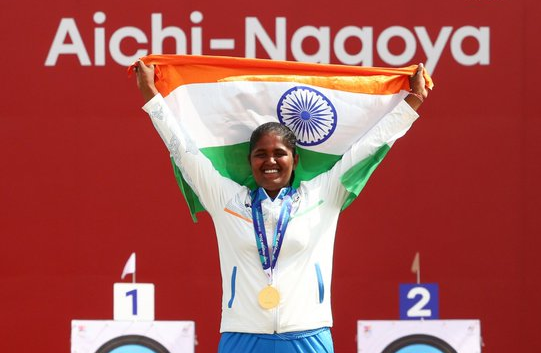
Okazaki, Oct 2026 : Seventeen-year-old Kumkum Mohod etched her name in Indian archery history on Saturday, winning the Asian Games individual recurve gold medal after defeating South Korea’s Yejin Oh in a dramatic shoot-off.
The Indian teenager prevailed 6-5 after the final was tied at 5-5 following five closely contested sets. With the gold medal to be decided by a single arrow, Oh shot an 8, before Kumkum responded with a perfect 10 to complete a remarkable comeback and claim the title.
The victory also earned India an individual quota place for the Los Angeles 2028 Olympic Games. Kumkum and Oh secured one quota place each for their respective countries through their performances in the individual competition.
Kumkum had to overcome an early setback in the final. Oh began strongly, taking the opening set 29-27 to move 2-0 ahead. The second set ended 29-29, allowing the South Korean to retain the advantage and move 3-1 ahead.
The Indian teenager responded with a brilliant third set. She produced three consecutive 10s for a perfect score of 30, while Oh finished with 29. The result brought Kumkum back into contention and levelled the match at 3-3.
Oh regained the initiative in the fourth set, edging Kumkum 28-27. The victory gave the South Korean a 5-3 lead and left her just one set point away from winning the Asian Games title.
Kumkum, however, responded under intense pressure.
Facing elimination, she opened the fifth set with a 10 and followed it with two more perfect shots. Her flawless 30 put the pressure back on Oh, who could manage only 28. The result forced the gold-medal contest into a one-arrow shoot-off with the scores level at 5-5.
The shoot-off provided a fitting conclusion to Kumkum’s extraordinary campaign. Oh shot an 8, leaving the Indian needing only a strong final arrow. Kumkum kept her composure and sent her arrow into the 10-ring to seal the gold medal.
The triumph completed an unprecedented individual campaign for the teenager.
Kumkum had entered the knockout stage after qualifying 10th in the ranking round. Her run then gathered momentum as she eliminated South Korea’s reigning world champion and Olympic team gold medallist Kang Chaeyoung in the quarterfinals.
The victory over Kang was followed by another major challenge in the semifinals. Kumkum faced China’s Jingyi Zhu, the silver medallist at the 2025 World Championships, and produced a composed 6-2 victory.
The semifinal itself showcased the teenager’s ability to handle pressure. Kumkum won the opening set 28-27 after Zhu began with an 8. The second set produced six consecutive 10s, ending 30-30 and leaving Kumkum 3-1 ahead.
Zhu appeared to regain momentum in the third set after opening with a 10. Kumkum’s first arrow was initially scored as an 8, but she recovered with two successive 10s. A review subsequently upgraded the first arrow to a 9, resulting in a 29-29 tie and giving Kumkum a 4-2 lead.
In the fourth set, both archers began with 9s before finding the 10-ring with their second arrows. Zhu then scored a 9, leaving Kumkum needing a 10 to win the semifinal. She delivered once again, finding the centre of the target to secure a 6-2 victory and become the first Indian woman to reach the Asian Games individual recurve final.
Kumkum has now gone one step further by becoming the first Indian woman to win the Asian Games individual recurve title.
Her victory also marks the first Asian Games individual recurve medal of any kind won by an Indian woman, making the achievement a significant milestone for the country’s archery programme.
China’s Yuwei Huang claimed the bronze medal after defeating compatriot Jingyi Zhu 6-4 in the bronze-medal contest.
For Kumkum, the gold caps a campaign in which she overcame two of the world’s leading archers before holding her nerve in a tightly contested final. At just 17, she leaves the Asian Games with an individual gold medal and an Olympic quota place for India, marking a historic chapter in Indian archery.