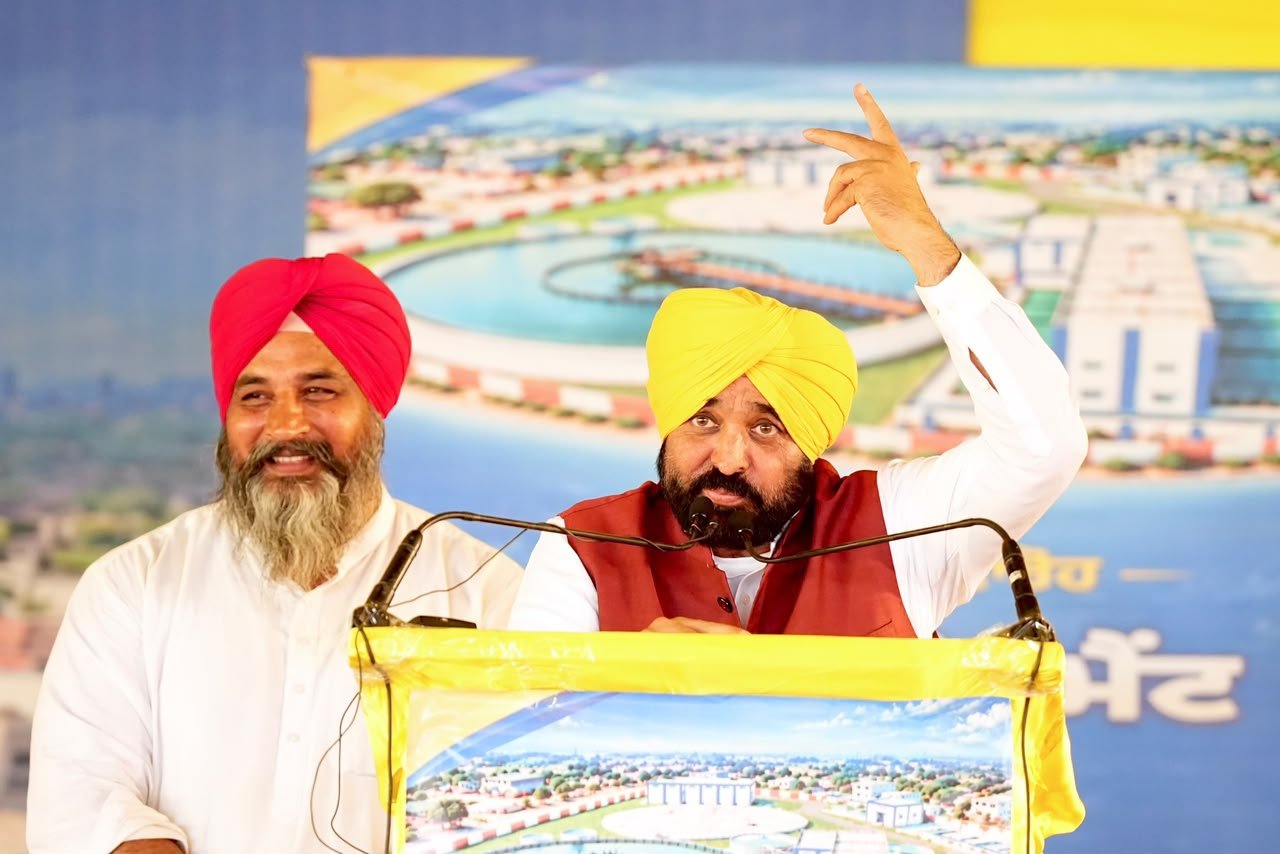
PATIALA | Chief Minister Bhagwant Singh Mann on Monday dedicated two state-of-the-art Water Treatment Plants, built at a cost of ₹432.65 crore at village Mandoli in Ghanaour constituency of Patiala, providing a major boost to access to safe drinking water across the region. The project will supply clean canal water daily to 316 villages across five Assembly constituencies, covering 4.50 lakh residents and 70,000 households through a 752-kilometre pipeline network. Besides addressing the groundwater crisis and tackling contamination, including fluoride, the project will provide a long-term solution to drinking water challenges, reaffirming the Punjab Government’s commitment to making clean drinking water accessible to every household.
Sharing a few snippets from this occasion, CM Bhagwant Singh Mann stated: “Today, dedicated two new Water Treatment Plants built at a cost of ₹432 crore to the people at village Mandoli in Patiala. Now, 316 villages across five Assembly constituencies and 75,000 households will receive clean canal drinking water every day. This project will provide a permanent solution to the problem of contaminated water, including fluoride contamination, and will serve as a lifeline for residents. The health of Punjabis remains our top priority.”
Addressing the gathering, CM Bhagwant Singh Mann said, “Today is a historic day for the districts of Patiala and Fatehgarh Sahib as three major projects worth around ₹432 crore is being dedicated to the people. Access to clean drinking water is directly linked to public health, and these projects will prove to be a lifeline for the people. Due to the high concentration of fluoride and heavy metals in groundwater in both districts, the decision has been taken to supply canal-based drinking water.”
The Chief Minister said, “Water treatment plants have been established at Mandoli and Pabri to treat canal water, and these plants have a combined capacity to treat 69 million litres of water every day. The Mandoli plant in Patiala district has been established at a cost of ₹266.20 crore, while the Pabri plant in Patiala district has been set up at a cost of ₹166.46 crore. These projects will benefit 316 villages across six Assembly constituencies, and more than 5 lakh people living in approximately 75,000 households will receive an uninterrupted supply of potable canal water.”
He said, “Out of the 316 villages, 250 are those where groundwater quality is affected, while the remaining 158 villages fall along the transmission route. These projects are particularly significant as they will reduce dependence on groundwater and help conserve underground water resources. Water testing laboratories have been established at all three project sites, and water samples are tested daily, both before and after the treatment process.”
The Chief Minister said, “It is unfortunate that even 80 years after Independence, people in these villages were still deprived of the basic necessity of clean drinking water. This work should have been completed decades ago, but previous governments completely ignored the needs of Punjab’s people. We have taken up this long-pending responsibility and ensured access to clean drinking water for thousands of families.”
CM Bhagwant Singh Mann said, “Testing reports of these laboratories are sent every month to the State-Level Water Testing Laboratory. A key feature of these projects is the installation of a Supervisory Control and Data Acquisition (SCADA) system at the water treatment plants and every water storage tank to ensure continuous monitoring and quality control of the water supply.”
The Chief Minister said, “A total of 752 kilometres of DI transmission pipeline has been laid to ensure the supply of water to every household. Additionally, 1,216 kilometres of pipelines have been upgraded across the 316 villages. Uninterrupted water supply is now being ensured through 322 water storage tanks under the existing water supply schemes in these villages.”
He further said, “The company that has executed these projects has also been entrusted with their operation and maintenance for a period of 10 years. Water Supply and Sanitation Committees have been constituted in all 316 villages to ensure community participation, effective operation and monitoring of the projects.”
Now Clean Drinking Water Is Reaching Our Homes. We’re Very Happy With This Initiative: Gurpreet Singh, Resident Of Patiala District
Gurpreet Singh, Resident Of Patiala District, stated, “Earlier, we faced problems with the quality of groundwater, and getting clean drinking water was a major concern for our families. Now canal water is being treated and supplied directly to our homes, and our household tanks are also getting filled with clean water. This has brought great relief to us because clean drinking water is something every family needs. No previous government undertook work on such a large scale to solve this problem across so many villages. We sincerely thank CM Bhagwant Singh Mann for taking this initiative and providing relief to thousands of families.”
Our Families No Longer Have To Worry About Getting Clean Drinking Water; This Is A Big Relief: Harpreet Kaur, Resident Of Sanaur
Harpreet Kaur, Resident Of Sanaur, said, “Earlier, we were concerned about the quality of groundwater and its impact on our families. Now clean treated canal water is reaching our homes, making our daily lives much easier. We can store this water in our household tanks and use it for our everyday needs without the same concerns we had earlier. It is heartening to see such extensive work being undertaken across hundreds of villages. Previous governments did not take up such a large-scale initiative to address this basic need. We appreciate the efforts of CM Bhagwant Singh Mann and his government for bringing clean drinking water to our villages.”
Bhagwant Mann Govt Strengthens Water Security, Safeguards Public Health And Transforms Water Infrastructure Across Punjab
The Punjab Government has undertaken major infrastructure initiatives to ensure safe drinking water, protect public health and address the growing groundwater crisis. Under the ₹432.65 crore Bulk Surface Water Initiative, state-of-the-art Water Treatment Plants (WTPs) have been established at Pabra and Mandouli in Patiala, benefiting 316 villages. The project will provide sustainable drinking water facilities to approximately 75,000 households, serving a population of 4,50,421, and is designed to meet the region’s drinking water requirements up to 2049.
Punjab is extracting groundwater at 156.36% of its natural recharge capacity, an unsustainable situation that highlights the urgent need to conserve underground water resources. The situation in Patiala is particularly concerning, with groundwater recharge standing at 1.01 billion cubic metres (BCM) against extraction of 1.89 BCM, while the extractable limit is only 0.9 BCM. This represents an exploitation level of approximately 208%, meaning groundwater is being extracted at more than twice the rate at which nature can replenish it.
The Punjab Government identified excessive concentrations of fluoride and heavy metals, including aluminium, lead, sulphate, arsenic and uranium, beyond permissible safety limits in 316 villages across Ghanaur, Rajpura, Sanour, Patiala Rural and Shambu Kalan. The establishment of canal-based water treatment infrastructure addresses these water quality concerns and provides safer drinking water to local communities.
The two Water Treatment Plants at Pabra and Mandouli have a combined treatment capacity of 58 million litres per day (MLD). The treated water is distributed through 259 Overhead Service Reservoirs (OHSRs), benefiting approximately 75,000 households through a pipeline network spanning 752 kilometres and serving a total population of 4,50,421. These plants have been designed to meet the drinking water requirements of the region up to 2049, ensuring long-term water security.
The plants are equipped with sophisticated surveillance and monitoring infrastructure to ensure efficient operations and consistent water quality. Fully automated Supervisory Control and Data Acquisition (SCADA) systems, supported by centralised dashboards, enable real-time monitoring of raw and treated water flow. The reservoirs have automatic level sensors, overflow alarms and self-actuating pumps to ensure uninterrupted and efficient water supply.
Each facility also has advanced laboratory infrastructure for pH and turbidity assessment, ensuring that water quality is monitored before distribution to the public. These technological interventions strengthen operational efficiency and help maintain drinking water quality standards.
Bhagwant Mann Govt’s Major Push For Clean Drinking Water To Benefit 78 Lakh Urban Residents
The Bulk Surface Water Supply Projects in Ludhiana, Amritsar, Jalandhar and Patiala are aimed at providing sustainable drinking water facilities to a cumulative population of 78 lakh residents. These major infrastructure developments have a combined water treatment capacity of 1,410 MLD, supported by more than 500 kilometres of rising main and distribution pipelines.
The infrastructure includes 224 new Overhead Service Reservoirs (OHSRs), Underground Reservoirs (UGRs) and pumping stations. These projects will facilitate the transition of urban centres from overexploited groundwater reserves to sustainable surface water systems, reducing pressure on groundwater resources and strengthening long-term drinking water security.
The projects also involve comprehensive network upgrades. However, their execution continues to face certain bottlenecks, including land acquisition, NOC clearances and labour constraints.
Punjab Govt Expands Sewage Treatment Capacity To Approximately 2,676 MLD By December 2027
Punjab has significantly expanded its sewage treatment infrastructure, with 152 Sewage Treatment Plants (STPs), having a combined treatment capacity of 2,243.7 MLD, currently operational across 23 districts. This includes completed and rehabilitated treatment plants.
The overall sewage treatment capacity is expected to increase to approximately 2,676 MLD by December 2027, with the addition of around 58 new STPs. These include two major treatment plants of 50 MLD each at Amritsar and Zirakpur. The expansion will further strengthen the state’s wastewater treatment infrastructure and sewage management capacity.
114.24 Kilometres Of Desilting Work Reported Across Patiala District
A total of 114.24 kilometres of desilting work has been reported across various Urban Local Bodies (ULBs) in Patiala district, reflecting the ongoing infrastructure work being undertaken across the district.