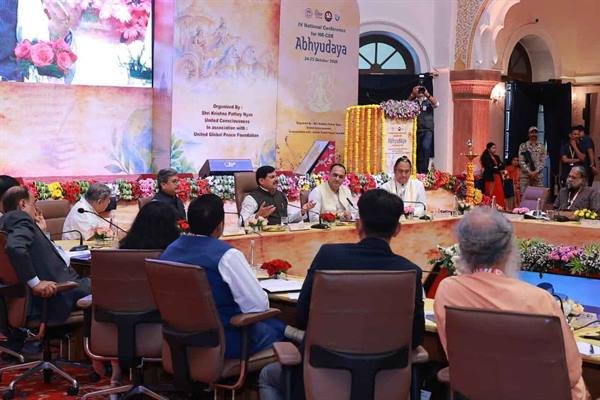
Chief Minister inaugurates two-day Fourth National HR–CSR Conference ‘Abhyudaya 2026’
Bhopal, October 2026: Madhya Pradesh Chief Minister Dr Mohan Yadav has said that the state government will extend full support and assistance to researchers and institutions undertaking in-depth studies and analysis of the life and teachings of Lord Shri Krishna.
“Where the Bhagavad Gita ends, the rise of life begins. The entire life of Lord Shri Krishna is an ideal for our society, and all of us learn something from his life every day,” the Chief Minister said.
Dr Yadav was addressing the Fourth National Conference on Human Resources and Corporate Social Responsibility (HR–CSR), titled ‘Abhyudaya 2026’, at the Kushabhau Thakre Auditorium in Bhopal on Saturday. He inaugurated the two-day conference by lighting the ceremonial lamp. The event will continue until October 25.
The Chief Minister described Lord Krishna as a great champion of the democratic traditions of his time, saying that he upheld both his moral responsibilities and his duties towards society and governance under every circumstance.
He pointed out that although Lord Krishna defeated the powerful ruler Kansa, he did not occupy the throne himself and never insisted on being called a king. He also consistently honoured his friendship with Sudama.
Dr Yadav said the Madhya Pradesh government was developing locations associated with the journeys of Lord Rama and Lord Krishna as pilgrimage destinations under the Shri Ram Van Gaman Path and Shri Krishna Pathey initiatives.
Lord Krishna’s life offers lessons in leadership and social harmony
The Chief Minister said there was a need to examine the lives of Lord Krishna and other deities, particularly the challenges they faced and the ways in which they found solutions for the welfare of humanity.
He recalled that Lord Krishna was born in prison and that both his parents and he himself endured considerable hardships during his early life.
Highlighting Krishna’s commitment to his promises, Dr Yadav narrated the episode in which Krishna had promised Mother Yashoda that he would eat butter from her hands after returning from Mathura following Kansa’s death. When he later met his biological mother, Devaki, in prison and she offered him butter, Krishna declined because he had already promised Yashoda that he would eat it from her hands.
Such episodes, he said, teach people how to move forward while taking society along with them. He also noted that Krishna’s use of a peacock feather symbolised the encouragement of a culture that respects and worships nature.
The Chief Minister further observed that Krishna did not assume power after defeating Kansa and ensured that Yudhishthira occupied the throne after the Mahabharata war. Even after settling in Dwarka with his family, Krishna did not automatically appoint his son as successor. Instead, he believed that responsibility should be entrusted to the most deserving person.
Dr Yadav drew parallels with Emperor Vikramaditya, saying both figures represented democratic values and did not consider kingship an end in itself. He added that Dwarka was established to encourage entrepreneurship and social harmony.
Krishna’s teachings relevant to education and governance
The Chief Minister recalled that Lord Krishna and Sudama studied together at the Sandipani Ashram in Ujjain. He said the state’s school education system was also moving forward with an emphasis on social equality and harmony.
According to Dr Yadav, Krishna’s life offers lessons in democratic governance, entrepreneurship, friendship, respect for parents and military discipline.
He stressed that governance should be viewed as a responsibility to serve people rather than merely a position of authority. Dedication to duty and the application of knowledge through research were among the important lessons that could be drawn from Krishna’s life.
Referring to Krishna’s killing of Narakasura, he said the episode represented an example of social justice. He called for more events across the country to examine Krishna’s personality and teachings through the Shri Krishna Pathey initiative.
Focus on skills, industrial investment and youth development
Speaking about Madhya Pradesh’s achievements, Dr Yadav said athletes from the state had won 11 medals at the recent Asian Games, including five gold medals. The state currently operates 18 sports academies through the government.
He also announced that the state government had declared plans to establish three skill universities.
During an interaction with industry representatives, the Chief Minister highlighted the Global Skill Park in Bhopal and said Madhya Pradesh was among the fastest-growing destinations for industrial investment. The government remained committed to developing the skills of young people, he added.
A representative of the Tata Group expressed interest in expanding the group’s skill development activities in Madhya Pradesh.
Dr Yadav also referred to the challenge of Naxalism in the state, saying Madhya Pradesh had taken an early lead in ending the influence of left-wing extremism under Prime Minister Narendra Modi’s leadership.
He said the state was conducting campaigns against drug abuse and promoting yoga under the National Education Policy. These initiatives, he added, could contribute to efforts to combat addiction. The government was also expanding the number of Ayurveda and other AYUSH colleges and undertaking initiatives to promote yoga and wellness.
Government working to preserve spiritual and cultural heritage
Additional Chief Secretary for Culture and trustee secretary of the Shri Krishna Pathey Trust, Shiv Shekhar Shukla, said the state government was committed to protecting its heritage and that the Chief Minister was personally leading the initiative.
He explained that sites associated with Lord Krishna were being developed as pilgrimage destinations under the Shri Krishna Pathey project.
Shukla also referred to Lord Rama’s significant period of life in Chitrakoot, Madhya Pradesh, and the spiritual significance of Omkareshwar, where Adi Shankaracharya is traditionally associated with attaining knowledge on the banks of the Narmada and subsequently travelling across India to spread Sanatan Dharma.
He said the government was working to preserve these locations and had established Ekatma Dham at Omkareshwar. Such initiatives would also create opportunities for religious and historical tourism.
Conference convenor Dr Vikrant Singh Tomar said the Chief Minister had given Madhya Pradesh the vision of ‘Abhyudaya’, a concept rooted in the Bhagavad Gita. He observed that inner peace could lead to spiritual prosperity and said the state was progressing under Dr Yadav’s leadership while preserving its religious, cultural and intellectual heritage.
He also outlined the objectives and programme of the two-day conference, noting the government’s commitment to industrial development and making Madhya Pradesh developed and self-reliant.
Integrating ESG principles with Indian civilisational wisdom
The fourth national HR–CSR conference, titled ‘Abhyudaya – Integrating ESG and Civilisational Wisdom for Comprehensive Wellbeing’, seeks to explore how environmental responsibility, social welfare and good governance can be integrated with India’s civilisational knowledge and ethical traditions.
Organised with the participation of the United Council for Ancient Wisdom, Shri Krishna Pathey Trust and the Madhya Pradesh government’s Culture and Culture and Tourism departments, the conference also received support from the United Global Peace Foundation.
Its objectives include connecting concepts such as Karma Yoga, Lok Sangraha and Dharma with human resources, corporate social responsibility, leadership and institutional decision-making.
The conference aims to develop practical approaches and policy recommendations for environmental responsibility, inclusive social development and ethical governance, while encouraging collaboration among government bodies, industry, educational institutions and social organisations.
Among those attending were the Chief Minister’s cultural adviser Shri Shriram Tiwari, Padma Shri Dr H.R. Nagendra, Shri Advaita Gananayak, leading industry representatives, eminent academics, social workers, scholars of Indian knowledge traditions and corporate representatives from major companies. Dr Padma Shri Agush Indra Udyana, who travelled from Indonesia, presented a traditional bell to the Chief Minister.