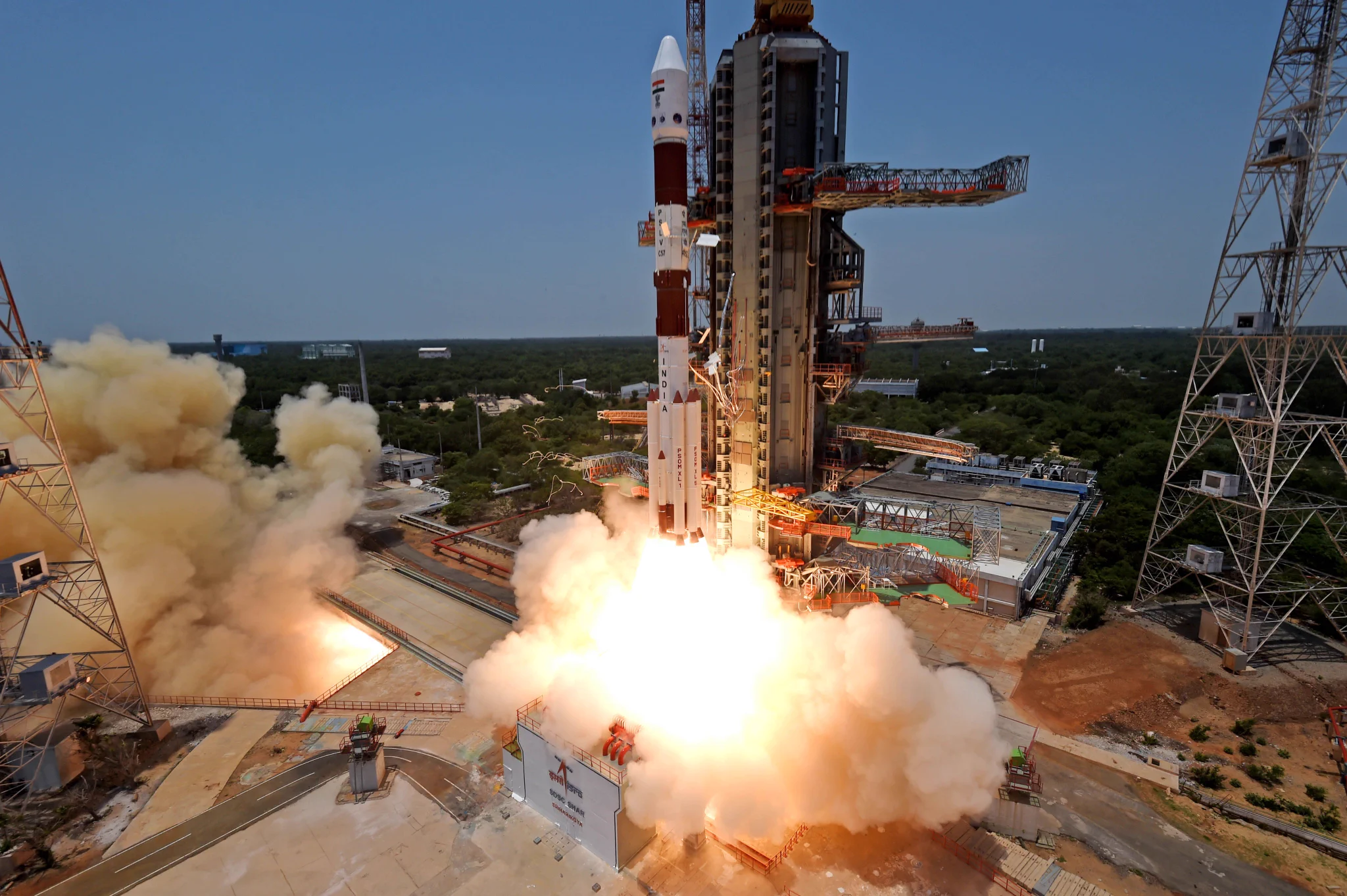
From Chandrayaan-3 and Aditya-L1 to Gaganyaan and the proposed Bharatiya Antariksh Station, India is advancing scientific exploration while strengthening manufacturing, employment and socio-economic development.
New Delhi, Oct 2026 : India is steadily emerging as a significant global space power, expanding its capabilities from satellite-based development applications to advanced planetary exploration and preparations for human spaceflight, according to an article published in Tanzania’s The Guardian newspaper.
Tracing the country’s journey from the launch of Aryabhata in 1975 to recent missions such as Chandrayaan-3, Aditya-L1 and SpaDeX, the article highlights India’s growing technological capabilities and its long-term plans for Gaganyaan, the Bharatiya Antariksh Station and a future crewed lunar mission.
It notes that India’s space programme is no longer limited to rockets, satellites and scientific missions. It has become an important driver of innovation, industrial development, employment, scientific research and socio-economic transformation. Space-based technologies now support communications, agriculture, education, healthcare, navigation, disaster management, environmental protection and numerous everyday economic activities.
The successful Chandrayaan-3 mission in 2023 demonstrated India’s ability to execute a complex lunar landing. Subsequently, Aditya-L1 expanded the country’s scientific capabilities by studying the Sun, while the SpaDeX mission demonstrated orbital docking technology, an important capability for future complex space operations.
India is also preparing for Chandrayaan-4, a lunar sample-return mission approved in 2024. Unlike a conventional lunar landing, a sample-return mission requires multiple launches, rendezvous and docking operations, collection of lunar material, ascent from the Moon’s surface and the safe transportation of samples back to Earth.
According to the article, these operations demand a substantially higher level of technological sophistication and represent another step in India’s expanding planetary exploration ambitions.
The country’s plans extend beyond the Moon. The proposed Shukrayaan, or Venus Orbiter Mission, is targeted for launch in March 2028 and is intended to study Venus’s atmosphere, surface and subsurface. Such observations could contribute to a better understanding of planetary evolution and the conditions associated with habitability.
Meanwhile, Aditya-L1, positioned approximately 1.5 million kilometres from Earth, studies solar activity and space weather. Its observations can help scientists improve their understanding of solar phenomena and their potential effects on satellites, communications and other space-based systems.
Human spaceflight and a space station
Gaganyaan represents a major transition in India’s space programme. Human spaceflight requires stringent safety standards, including reliable crew escape systems, life-support technologies, parachutes, re-entry systems and extensive testing.
India has adopted a phased approach, using uncrewed missions to validate critical technologies before sending astronauts into space. This process is intended to establish the reliability required for human missions.
The Gaganyaan programme is part of a broader long-term roadmap. India plans to begin development of the Bharatiya Antariksh Station with its first module in 2028, with the complete station envisaged by 2035. The roadmap also includes a crewed Indian lunar mission by 2040.
The progression from satellites and robotic exploration to astronauts, an indigenous space station and eventually a human mission to the Moon illustrates the scale of India’s ambitions, the article observes.
Space technology for development on Earth
Beyond exploration, the programme’s contribution to everyday life remains significant. Satellite systems support weather forecasting, agricultural planning, navigation, communications, disaster management and environmental monitoring.
Earth-observation satellites help identify vulnerable regions before floods, cyclones and landslides, while satellite communications can assist emergency response operations in remote areas where conventional infrastructure is limited.
Space-based data also supports environmental management by monitoring forests, water bodies, pollution, urban expansion and weather patterns. These applications strengthen climate monitoring, disaster preparedness and resource management.
Satellite communications can improve access to healthcare in underserved regions, while augmented and virtual reality technologies offer opportunities for medical education, training and specialised learning. Such applications help connect remote communities with services and expertise otherwise concentrated in urban centres.
Industrial growth and technological innovation
India’s space programme is also generating technological benefits across the wider economy. Advances in electronics, sensors, materials, communications, navigation and precision manufacturing are finding applications beyond space missions.
Technology transfers and domestic research are strengthening manufacturing capabilities and helping Indian companies participate in increasingly sophisticated supply chains.
The article cites more than 900 application-specific integrated circuits developed by ISRO’s Semi-Conductor Laboratory for railway locomotives as an example of technology moving from the space sector into other industries.
Such developments create a multiplier effect, generating intellectual property, specialised engineering skills, manufacturing expertise and commercial opportunities.
India’s evolving space programme is therefore shaping a broader development model in which scientific exploration and technological innovation support economic growth, public services and international cooperation. As the country advances towards human spaceflight and more complex planetary missions, its space capabilities are also expanding the potential for practical applications on Earth.
(Disclaimer :The content of this article is sourced from a news agency and has not been edited by the Mavericknews30 team.)