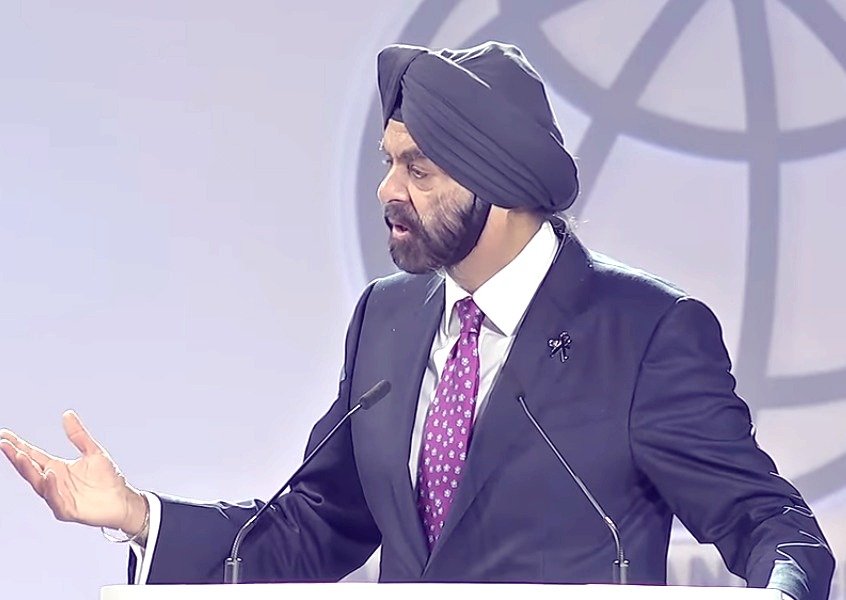
Bangkok; October 2026: Ajay Banga – President of the World Bank group while delivering a key address at the 2026 Annual Meetings at Bangkok has reiterated that: “we’re reminded that the people who build businesses, who create jobs, and who serve their communities are actually the ones who power the global economy. Most of those people run micro, small, or medium enterprises, MSME. They are the engine of the economy”, while asserting further that, “they represent 90% of firms. They employ 75% of workers in the developing countries. And by the way, their role will only grow in the coming years. So, over the next 10 to 15 years, 1.2 billion young people will reach working age in the developing world. And the same countries are expected to create only 420-odd million jobs”.
The World Bank chief has further stated that: “job creation is not automatic. It comes from businesses that can start, that can grow, that can hire, that can trade, and that can compete. And that is why WBG have built a job strategy around the foundations that businesses need, starting with infrastructure, both physical and human, with better governance, and then the private capital to be mobilised at scale. Last year, WBG committed 40 billion dollars to infrastructure, another 24 billion to better governance, together accounting for more than half of our financing. So, WBG are directing our financing into the pillars that could create jobs and attract private capital”.
This approach comes to life in five sectors with the greatest potential for job creation.
First, it is the Energy and infrastructure is the first one.
Second, is the Agribusiness, particularly to help small farmers remain competitive and productive
Third, is the Primary healthcare, better access to that across the world,
Fourth, is the tourism sector. It’s the single best multiplier of jobs per dollar invested.
Fifth & Finally, is the value-added manufacturing (VAM), everything from minerals and metals that the developed world needs and the emerging world is blessed with, but all the way to creative industries. The word that matters here - is value-added manufacturing, not just extraction, but creating higher local value-added jobs to enable some of the benefit that comes from these minerals and metals to also be shared with the people in the economy from where those minerals are coming.
MSMEs are the backbone of all five of these. They cannot create jobs, however, without funding. They cannot create jobs without the right capacity building. MSMEs in developing countries face a financing gap of over four trillion dollars a year. The reasons are structural. Under current regulations, a bank needs to hold roughly four times more capital when lending to an unrated small business than to a local AAA-rated corporation. Banks require hard assets such as real estate for collateral. MSMEs rarely have those. And small loan sizes do not offset a bank’s overhead costs. It’s an expensive model to originate and service. Fintechs do offer an alternative. You’re going to hear from some of them. But without a deposit base, their funding costs and therefore their risks are still high. And across the board, investors perceive MSMEs as riskier than they actually are because there is so little data on their actual credit performance. What do you end up with? High cost of credit at best or no credit at all at worst.
MSMEs may not have hard assets, but there’s something even better, and it’s called cash flow. The single most reliable indicator of repayment ability is your cash flow in a small business. The problem was WBG couldn’t see it, let alone forecast it. But now you can, because data and digitalisation are changing the game, transforming how firms operate, how they access the market, how they navigate regulation, and how they unlock finance. And that is the core of what the World Bank Group is trying to do here with the MSME strategy that WBG are launching today, using data and digital solutions to help MSMEs overcome the constraints at scale, making them the following four:
·visible,
·connected,
·enabled,
·funded.
First, visible: Fewer than one in three MSMEs in developing countries are digitised. Around 60% of payments are still in cash. There’s no track record. There’s nothing a lender can assess. However, digital fast payments, e-invoicing, and tax and utility payment data change all that. Every transaction then creates a data trail, what WBG call a data exhaust. Every payment builds a track record of repayment capacity. Data is actually the new collateral, and WBG are helping countries build it. Governments have an essential role: create the data, let it flow, but most importantly, enable lenders to use it. On fast payment systems, WBG have helped 20 countries build interoperable infrastructure in the last three years alone. On e-invoicing, and digital access to tax and utility data, eight countries. On open finance frameworks that can enable secure, privacy-protected access to that data, five more countries. What WBG have to do is redouble this effort and aim for higher numbers than 20, eight, and five.
Second, connected: Being visible is necessary, but it’s not a sufficient condition. MSMEs also need customers, they need suppliers, they need logistics, they need affordable services to grow. Most cannot afford their own accountant or their own compliance team. WBG think that it can help to fix that by investing in digital shared service providers that can deliver professional services to thousands of small businesses at a fraction of what each would pay individually. Services would be embedded into digital platforms so entrepreneurs can have step-by-step guidance, almost like an export plan, but made at their fingertips, while, helping in linking them to markets as the group is doing through Agri Connect, which digitally connects smallholder farmers and cooperatives to buyers, to financiers, and to shared infrastructure like storage. So that’s the second one, connected.
Third, enabled: Running a business should not require navigating a maze. Burdensome licensing, high compliance costs, and very weak insolvency frameworks push entrepreneurs to the margins of what they should be doing. WBG think that it can help countries cut red tape. Simpler licensing, simpler registration, fair rules for public contracts, and insolvency systems that allow an entrepreneur to fail, to learn, and come right back again to try again to win.
Over the past three years, WBG have helped 35 countries in cutting red tape, 10 countries in improving their insolvency frameworks, and 07 have reformed procurement and competition regulations to support MSMEs. Again, interesting numbers: 35, 10, and 07, and more of these needs to be done.
Fourth, funded: The world is changing very fast. Fintechs are already approving loans in 24 hours. They use AI-driven credit scoring, no balance sheet, no collateral. Their lending has reached roughly 400 billion dollars in the emerging markets. Aggregators, ride-hailing platforms, Grab, as an example is a partner, e-commerce marketplaces, major exporters, they sit on MSME transactions and receivable data. In fact, they’re becoming financiers themselves, and they can be a great way of accessing the vast majority of these micro and small enterprises. And then, of course, securitization can turn large pools of MSME loans into an asset class that attracts institutional investors, pension funds, asset managers, and the like, who have never touched this market before. Banks are trying to become fintechs. Fintechs are trying to become banks. The winners of the next decade will be those who marry the best of both: the liquidity, trust, and license of a bank with the speed, data intelligence, and digital reach of a fintech.
What World Bank Group (WBG) is trying to do, is to support all of them. If banks are willing to use digital data but are reluctant about venturing into the risk, WBG can help share it, giving them the breathing room to try a new model.
For fintechs and aggregators that hit a ceiling:
·WBG can step in with equity;
·WBG can step in with loans backed by their MSME receivables to help them scale.
In these context the WBG have already invested in over 100 fintechs and aggregators, with the confidence that it can do much more. WBG will also deepen ties with governments to streamline fintech licensing and create legal frameworks for asset-based lending and securitization. So, at the earliest stage, the microentrepreneur with an idea, the constraint is often not credit but equity. And that is why WBG are creating centers where entrepreneurs can get equity, mentorship, and the early support they need, because you cannot borrow your way to the first business you open. And most ambitiously, WBG are building the evidence base to persuade global standard setters to recognise that cash flow lending backed by digital data and adjust capital requirements accordingly.
Last year (2025), the World Bank Group has mobilised $112 billion in private capital, more than triple what it was mobilised four years ago. WBG invested that, by the way, alongside $120 billion of its own balance sheet. This clearly defines that WBG is not replacing its own balance sheet with private capital, but by enhancing the total available into the developing markets by bringing private capital to do what there is not enough public capital for.
Growth was broad-based in the private capital mobilisation. WBG has quadrupled in upper-middle-income countries, like Argentina, India, and Gabon; nearly tripled in lower -middle-income ones like Angola and Bangladesh; and 2.5X across Africa.
Meanwhile, IFC, grew its commitments in IDA and FCV countries to $12 billion, and they have managed to mobilised $11 billion in private capital on top of that. But the issue is the scale of the jobs, and the challenge demands World Bank Group go much further, especially in FCV countries.
MSMEs visible where cash still dominates, strengthen local banks and microfinance institutions and other intermediaries like aggregators who know these communities, have trust with them and can reach them, and then deploy pooled first-loss facilities to help de-risk private capital that would never enter those markets on their own. If WBG get that right, WBG do more than close the financing gap. WBG reach millions of businesses, millions of entrepreneurs that the traditional model could never touch. In that process, WBG create the jobs that the next generation is counting upon. Thank you very much for your support in this journey.
Team Maverick.