State to be established among India's leading destinations in science, technology and research: Chief Minister Vishnu Deo Sai
CM holds high-level meeting with Director and senior scientists of the Indian Institute of Science, Bengaluru
Major initiative to develop Chhattisgarh as a national hub for scientific research, higher education, technological innovation and medical technology
Detailed discussions held on potential collaboration between IISc and Chhattisgarh Government on three ambitious projects
Proposal to establish a world-class Material Characterisation and Testing Centre and an institute for science and mathematics teacher training
New opportunities to emerge for youth in artificial intelligence, semiconductors, biotechnology and advanced research
Emphasis on leveraging IISc expertise for modern medical research, digital health and affordable healthcare technologies
Chief Minister directs officials to assess the feasibility of proposed projects and prepare a concrete action plan
Raipur, November 2026: Chhattisgarh Chief Minister Vishnu Deo Sai has said that the state government is committed to strengthening the state not only through its natural resources but also through knowledge, science, technology and innovation.
“Our objective is to establish Chhattisgarh among the country's leading states not only in industrial and economic development but also in scientific research, higher education, modern technology and medical innovation,” he said.
The Chief Minister observed that the state's rich mineral resources, energy potential, industrial opportunities and talented human resources could be connected with modern scientific research to usher in a new phase of development.
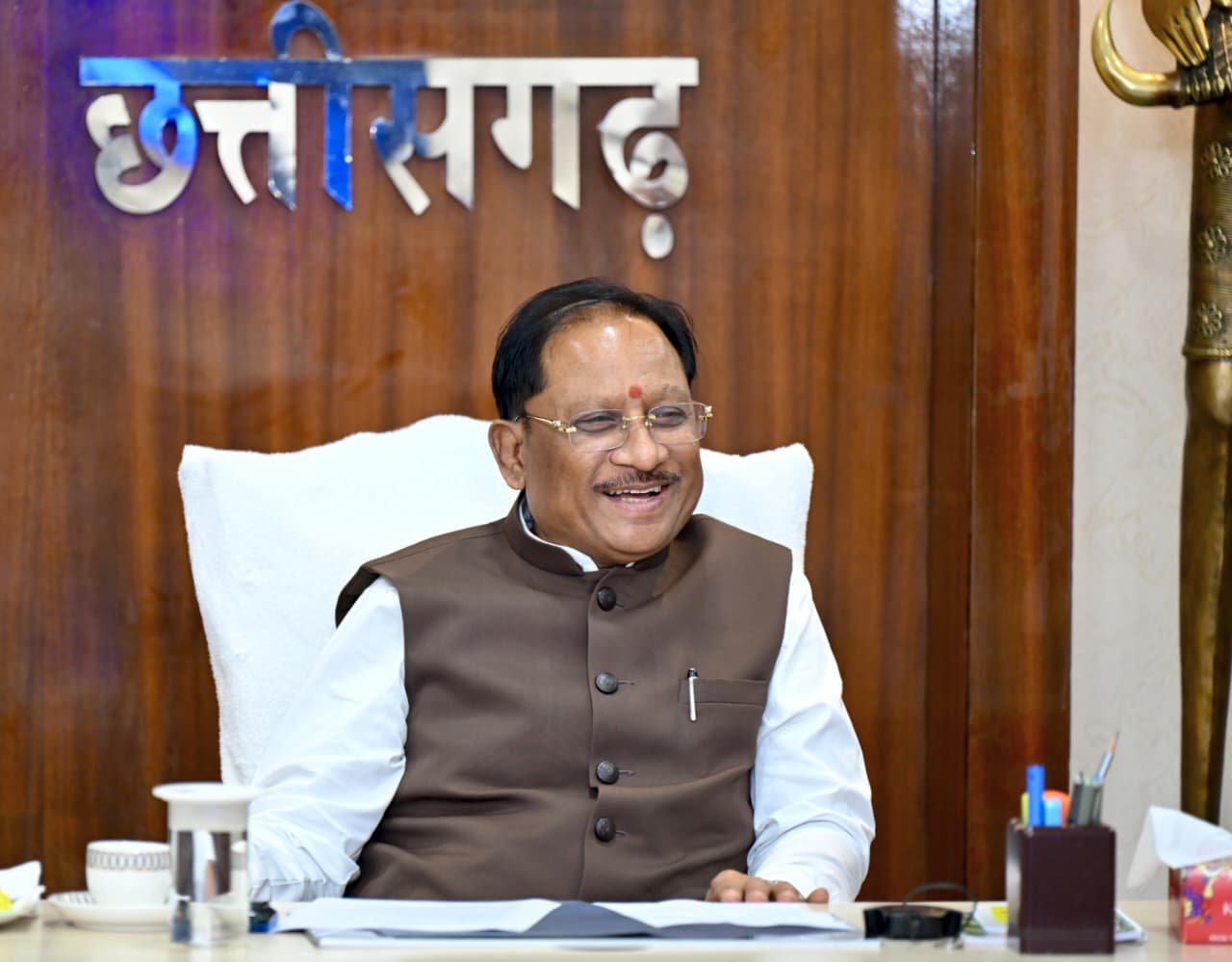
Sai was addressing a high-level meeting at his official residence in Raipur with Indian Institute of Science (IISc), Bengaluru Director Professor G. Rangarajan, senior scientists from the institute and senior state government officials. The meeting discussed possibilities of developing Chhattisgarh as a major centre for science, technology, higher education, skill development and medical research.
Detailed discussions were held on potential collaboration between IISc and the Chhattisgarh Government on three ambitious projects, including the scientific infrastructure required, institutional arrangements and the preliminary framework for implementation.
Welcoming the IISc delegation, the Chief Minister said the institute is among the most prestigious scientific and research institutions in India and the world. He stressed that its expertise, research capabilities and academic experience should benefit universities, technical institutions, industries, healthcare services and, particularly, the youth of Chhattisgarh.
Sai said that under the leadership of Prime Minister Narendra Modi, India is achieving new milestones in science, technology, space research, digital innovation and self-reliance. Scientific research, technological excellence and a highly skilled workforce will play a decisive role in realising the vision of a developed India. Chhattisgarh, too, is moving forward in line with this national vision.
He said the state government intends to develop world-class scientific and educational infrastructure whose benefits would extend beyond the present generation and serve generations to come. Investment in science and research, he added, is an investment in the state's long-term development, industrial competitiveness and the future of its youth.
The Chief Minister emphasised that the expertise of prestigious institutions such as IISc should not remain confined to major cities and leading educational institutions. He said there was no shortage of talent in rural, tribal and remote regions, including Bastar and Surguja. What was needed was better access to quality education, modern laboratories, scientific guidance and technical training.
He directed senior officials of the concerned departments to examine all possibilities of collaboration with IISc and assess the technical, financial and institutional feasibility of the proposed projects. A concrete, time-bound action plan should be prepared to translate the initiatives into reality. The state government, he said, would extend all possible support to these efforts.
Three ambitious projects to create a new foundation for scientific and technological development
The meeting discussed three major areas of potential collaboration between IISc and the Chhattisgarh Government. These include establishing a world-class Material Characterisation and Testing Facility in the state, developing a four-year integrated BSc-BEd institute to prepare outstanding science and mathematics teachers, and extending the expertise of IISc's Medical School to Chhattisgarh in modern medical research and healthcare technology.
The proposed projects are expected to create opportunities for developing advanced scientific infrastructure, providing quality higher education and training, promoting research-driven industrial development and expanding modern healthcare services.
World-class Material Characterisation and Testing Centre to strengthen industries and research institutions
The proposal to establish a world-class Material Characterisation and Testing Facility in Chhattisgarh received particular attention during the meeting. The proposed centre could prove highly beneficial to industries associated with minerals, steel, metals, energy, advanced manufacturing and critical minerals.
Chhattisgarh is among the country's major mineral-rich and industrial states. Advanced testing and research facilities are required to improve the scientific and technological utilisation of natural resources, develop new industrial technologies and enhance product quality. The proposed centre could play an important role in this direction.
The facility is envisaged to have advanced microscopy, X-ray-based analysis, high-temperature material testing, nanotechnology, studies of electronic and magnetic materials, and artificial intelligence-based scientific analysis.
These facilities would enable the study of the properties of metals and alloys, testing of advanced materials, development of new manufacturing technologies and scientific evaluation of industrial product quality. They could also expand research and innovation opportunities in defence, aerospace, automobiles, electronics, energy and other advanced industrial sectors.
The proposed centre is envisaged to have residential training capacity for approximately 600 researchers and students. It has been proposed that around 1,800 students be provided advanced scientific research and technical training over three years.
Once developed, the centre would provide high-level testing and research facilities to universities, engineering institutions, scientists, researchers, startups and industrial units in Chhattisgarh. It could reduce dependence on foreign institutions for scientific testing, lower research costs and time, and improve the technological competitiveness of industries.
Sai said connecting Chhattisgarh's mineral wealth and industrial capabilities with scientific research and modern technology would give a new direction to the state's economic development. It would also create opportunities for research-based industries, technological innovation and highly skilled employment.
Proposed institute to prepare outstanding science and mathematics teachers
The meeting also discussed the establishment of a specialised institute under the academic guidance of IISc to run a four-year integrated BSc-BEd programme. The initiative aims to bring about long-term improvements in the quality of science and mathematics education in the state.
In line with the National Education Policy, the proposed institute would focus on preparing a new generation of highly trained and skilled teachers equipped with modern teaching methods.
Along with core subjects such as physics, chemistry, biology and mathematics, the curriculum would emphasise modern pedagogical methods, scientific research, communication skills, critical thinking, problem-solving and creative expression.
The proposed infrastructure includes 14 modern teaching laboratories, residential facilities for 600 students, a well-equipped library, digital learning facilities, modern lecture halls, sports facilities and residential accommodation for teachers and staff. The appointment of 25 full-time teachers is also envisaged.
Discussions were held on the possibility of IISc providing academic guidance in curriculum development, laboratory infrastructure, teacher training, quality assurance and promotion of a research-oriented academic culture.
The Chief Minister said quality school education forms the foundation of scientific thinking and technological competence. Excellent teachers are essential to encourage students to take an interest in science and mathematics and develop a modern scientific outlook.
He said the initiative would help create a new generation of highly trained science and mathematics teachers in the state. It could positively influence the entire school education system, including government schools, and particularly improve access to quality science education for students in rural and tribal regions.
Scope for collaboration in medical research, digital health and modern healthcare technologies
The third major initiative discussed during the meeting involved exploring ways to bring the academic, scientific and research capabilities of IISc's Medical School to Chhattisgarh.
The proposal prioritises affordable medical diagnostic technologies, modern medical equipment, digital health, artificial intelligence-based healthcare services, clinical research and the development of skilled human resources in the medical sector.
Instead of establishing a full-fledged medical school in the initial phase, the meeting discussed the possibility of adopting a hub-and-network model. Under this arrangement, IISc could be connected with hospitals, medical colleges, universities, government institutions and industrial units in Chhattisgarh to promote joint research and technological development.
The discussions covered the establishment of joint research laboratories, medical technology testing and validation centres, fellowships, specialised training programmes and the practical application of modern medical technologies.
The meeting was informed that the Tata IISc Medical School in Bengaluru is an important initiative based on the integration of science, engineering and medicine. Its areas of specialisation include cancer, cardiology, neurology, endocrinology, organ transplantation and robotic surgery.
The institute's scientific and technological experience could benefit medical research, improve the quality of healthcare services and support the development of modern treatment technologies in Chhattisgarh.
Sai said the state government's priority was to ensure accessible, affordable and quality healthcare for every citizen. Modern technology and scientific research could play an important role in making healthcare services more effective. Technological innovation would be particularly useful in improving medical diagnostics, early disease detection and access to modern healthcare in remote and tribal regions.
Focus on connecting youth from Bastar and Surguja with scientific research and advanced technical training
The Chief Minister said talented young people were present in abundance across Chhattisgarh's tribal and rural regions. They needed opportunities to connect with reputed national scientific institutions, receive training in modern laboratories and pursue careers in scientific research.
The meeting explored the possibility of providing undergraduate and postgraduate students in the state with scientific mentorship from IISc, summer and winter research internships, training in modern laboratory techniques and lectures by eminent scientists.
Specialised training programmes in semiconductor technology, artificial intelligence, biotechnology, basic sciences and other emerging technologies were also discussed.
Sai said students from government educational institutions and young people from rural and tribal communities should be given priority in these opportunities. He expressed the aspiration that talented youth from Bastar and Surguja should also conduct research at prestigious scientific institutions, develop new technologies and establish their identities at national and international levels.
Discussions on water conservation and local technological innovation in Bastar and Sukma
The meeting also explored the use of IISc's expertise in water conservation, groundwater replenishment and scientific technologies suited to local conditions.
Scientists from IISc shared information about work involving pumping technologies powered by the energy of flowing water, without electricity, in Bastar, Sukma and other areas.
Based on hydraulic ram and turbine pumps, these technologies could be particularly useful in remote forest regions where operating conventional electricity-based water supply systems is difficult. Their use, depending on local water sources and geographical conditions, could improve water availability and meet the needs of rural communities.
The meeting also discussed IISc's experience in treated wastewater recycling, reservoir replenishment and groundwater conservation.
An example was presented of a project in Karnataka's Kolar district, where 440 million litres of treated water are supplied daily to 137 reservoirs. The meeting considered examining the usefulness of such scientific and technological innovations to develop solutions suited to Chhattisgarh's water conservation, management and local requirements.
The Chief Minister said scientific research would have real meaning only when its benefits reached the last person in society. Science and technology should also be used to make rural life easier, conserve natural resources and find sustainable solutions to local problems.
Coordination among science, education, industry and healthcare essential for developed Chhattisgarh
Chief Minister Vishnu Deo Sai said the overall and balanced development of Chhattisgarh required education, science, research, industry, skill development and healthcare services to progress in coordination with one another.
He said collaboration with prestigious institutions such as IISc would help develop modern scientific infrastructure, promote advanced research, meet the technological requirements of industries and create new opportunities for young people.
The Chief Minister said the government wanted Chhattisgarh to be recognised in the coming years not only as a state rich in mineral wealth and natural resources but also as a major centre of knowledge, scientific research, technological innovation and excellence in human resources.
He added that science and innovation would play an important role in achieving the vision of Viksit Chhattisgarh 2047. The proposed collaboration with IISc could prove to be a significant long-term initiative in taking the state's scientific and technological capabilities to new heights.
Those present at the meeting included IISc Bengaluru Director Professor G. Rangarajan; Dean of Administration and Finance Professor P.S. Anil Kumar; Dean of the Division of Mechanical Sciences Professor Satyam Suvas; and Dean of the Division of Biological Sciences Professor Satish Raghavan.
Also present were Chhattisgarh Government Investment Commissioner posted in New Delhi Ritu Sen; Secretary to the Chief Minister Rahul Bhagat; Higher Education Department Secretary Avinash Champawat; Health Department Secretary Amit Kataria; Skill Development Department Secretary Dr Basavaraju; and senior officials of the concerned departments.