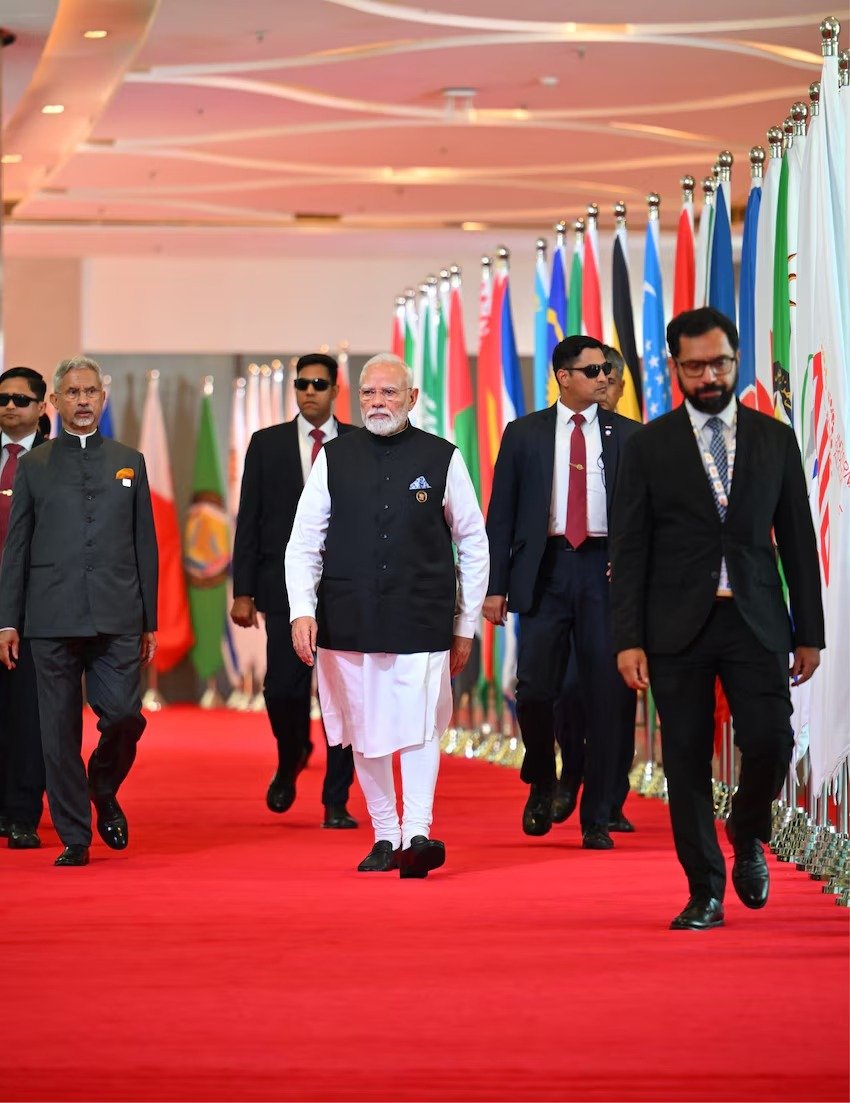
New Delhi, Sept 2026 : Prime Minister Narendra Modi on Saturday called for a greater role for the Global South in shaping international rules and decision-making, stressing that developing nations must move from being “rule-takers” to “rule-shapers”.
Addressing the opening session of the BRICS Summit on “Inclusive Global Governance and Strengthening Multilateralism” in New Delhi, Modi said the Global South remains at the forefront of global crises but continues to have limited representation in the institutions where major international decisions are taken.
He called for transforming the existing global governance architecture from a “pyramid of privilege” into a “platform of partnership”, where every nation has a voice, every member has a stake and human development remains at the centre of global cooperation.
“While strengthening BRICS, we must also chart a course for global reform,” Modi said, describing the current global governance structure as a pyramid in which power and decision-making are concentrated at the top, while countries affected by those decisions often have little ability to influence them.
The Prime Minister proposed that BRICS members jointly formulate 10 proposals for global governance reform, with the objective of converting them into a BRICS reform roadmap by the next Summit.
He said the roadmap should focus on three key areas — representation, responsiveness and rule-making — to make global institutions more reflective of present-day realities.
On representation, Modi said reform of the United Nations Security Council could no longer be postponed. He called for text-based negotiations on the issue to be linked to a definite timeline and clear, tangible outcomes.
He also underlined the need for greater alignment between the structure of international financial institutions and contemporary economic realities. Voting power, leadership positions and policy priorities, he said, should reflect the contribution of countries driving global economic growth.
“Countries that drive global economic growth should also play an appropriate role in shaping global economic governance,” Modi said.
On rule-making, the Prime Minister stressed the importance of ensuring equal participation in defining the global rules that will shape the future. He pointed to areas such as artificial intelligence, cyberspace, outer space, biotechnology and critical technologies, saying these sectors are not only creating new opportunities but are also influencing the rules that will govern future development.
Modi called for transforming the Global South from a “rule-taker” into a “rule-shaper”, saying BRICS could play an important role in building the capabilities required for this transition.
He proposed that BRICS provide negotiation skills, practical training and legal expertise to young diplomats and policymakers from Global South countries. Such capacity-building, he said, could help developing nations participate more effectively in international negotiations and contribute to shaping emerging global norms.
On responsiveness, Modi highlighted the contribution of seafarers to global trade and pointed out that they often lack adequate support during difficult circumstances.
He called for the establishment of a “Seafarers' Emergency Support Network” to strengthen collective international responses and ensure timely assistance to seafarers during emergencies.
The Prime Minister's proposals underline India's push for a more inclusive and representative multilateral system in which developing nations have a meaningful role in shaping global institutions, economic governance and emerging international rules.
Through the BRICS platform, India is seeking to give practical shape to the voice of the Global South and promote a global governance framework based on partnership, equal participation and shared responsibility.