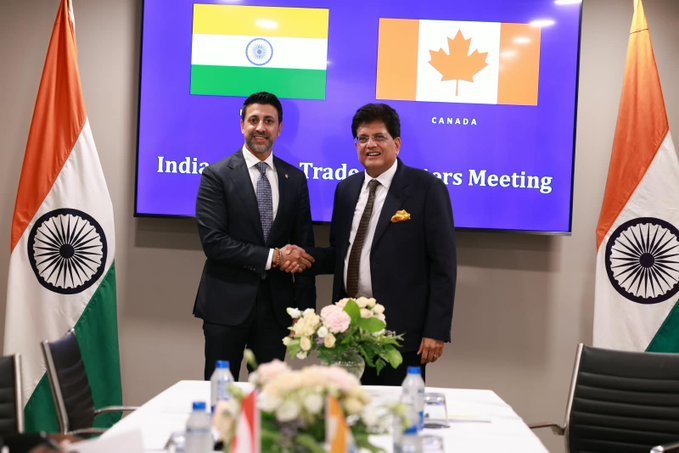
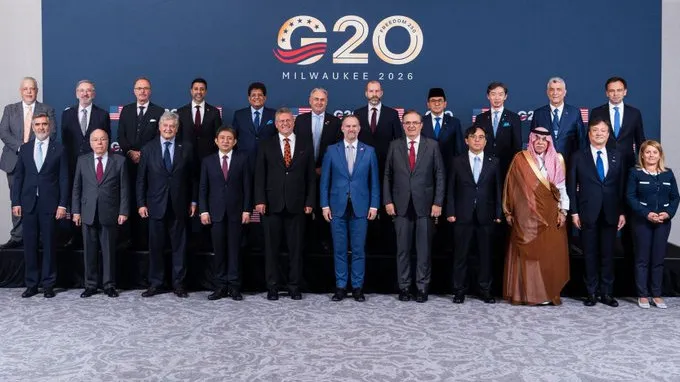
G20 trade ministers meeting in Milwaukee reached a unanimous agreement condemning the use of food and agricultural trade as a tool of political or economic coercion. However, divisions persisted over eliminating forced labour from global supply chains and reforming the World Trade Organization’s Most-Favoured Nation principle.
Milwaukee, Oct 2026 : Trade ministers from the Group of 20 (G20) economies have unanimously condemned the weaponisation of food for political or economic coercion, securing a rare consensus at a ministerial meeting that otherwise highlighted differences over forced labour, industrial overcapacity and the future of global trade rules.
The agreement was reached during the two-day G20 Trade Ministerial held in Milwaukee on September 30 and October 1 under the United States’ presidency of the grouping.
Ministers defined food weaponisation as targeted government actions intended to slow, stop, block or redirect trade in food, agricultural products or agricultural inputs to obtain unrelated geopolitical concessions.
US Trade Representative Jamieson Greer said the consensus reflected recognition that such practices posed serious humanitarian and economic risks.
“For decades, trade in food, agricultural products, and agricultural inputs has been weaponized to exert coercive pressure for economic or political reasons,” Greer said, adding that such actions threatened livelihoods, distorted competition and undermined confidence in the global trading system.
The joint statement warned that coercive trade measures could disrupt agricultural supply chains, undermine food security, particularly for vulnerable populations, and adversely affect farmers and other producers.
Distinction between coercion and domestic policy
A key element of the agreement was the distinction between coercive trade restrictions and legitimate domestic policy measures.
Ministers clarified that their concerns did not extend to measures adopted transparently and consistently with relevant international rules and norms to pursue legitimate domestic objectives, including food security.
The distinction was central to the discussions, as governments often introduce restrictions or regulations on agricultural trade for domestic policy reasons. The agreement sought to address the use of trade as a coercive instrument without automatically treating legitimate domestic measures as weaponisation.
While the ministers found common ground on food trade, they failed to achieve consensus on eliminating forced labour from global supply chains.
US, Mexico and Argentina issue separate statement
The United States, Mexico and Argentina issued a separate statement calling for stronger international action against goods produced using forced labour.
Greer praised the two countries for supporting the initiative, describing forced labour as an unacceptable human rights violation that also distorts global supply chains and competition.
The statement cited an International Labour Organization estimate that approximately 28 million people were engaged in forced labour worldwide in 2021, representing an increase of around 10 per cent over the preceding five years.
The three countries called on governments to strengthen cooperation and adopt measures addressing imports produced wholly or partly through forced labour. They also encouraged World Trade Organization (WTO) members to use the organisation's existing bodies to exchange information on imports and supply chains potentially linked to such practices.
According to the chair's statement, the proposal received support from most participants, although a handful of members opposed moving towards collective action.
The lack of unanimity underscored the challenges facing international efforts to establish common standards for labour practices and enforcement across increasingly interconnected supply chains.
Debate over WTO trade rules
Another significant issue discussed in Milwaukee was reform of the WTO's Most-Favoured Nation (MFN) principle, which generally requires members to extend equivalent trade advantages to other WTO members, subject to recognised exceptions.
Many participating countries described MFN as a fundamental pillar of the multilateral trading system. However, an increasing number of members indicated that examining how the principle operates and whether it could be improved would be worthwhile.
Ideas discussed included targeted adjustments to MFN rules, broader exceptions, alternative legal interpretations of existing exceptions and closed plurilateral agreements. Under the latter arrangement, participating countries would undertake stronger commitments and extend benefits within the participating group rather than automatically to all WTO members.
The chair's statement described the Milwaukee discussions as the beginning of further deliberations on possible MFN reform, rather than a final agreement on changes.
Further negotiations ahead
The ministerial meeting focused on four principal areas: food weaponisation, forced labour, structural excess capacity and reform of the MFN principle.
The differing outcomes demonstrated both the potential for cooperation on specific trade concerns and the continuing difficulty of reaching consensus on broader structural issues affecting global commerce.
The United States currently holds the G20 presidency and will hand it over to the United Kingdom in 2027. Further discussions are expected to continue as members consider the future direction of global trade governance and cooperation.